
Beautiful Plants For Your Interior
Beautiful Plants For Your Interior
Born from a fortunate innovation in 1960s recording studios, the flanger is a staple of modulation effects in music. Renowned for its metallic, spatial, and evolving sounds, it stands out for its ability to transform an audio signal by playing with phase shifting and time variations. This article explores the history and origins, operating principles, musical applications, and tools for mastering the flanger.
The flanger is part of the modulation effects like the chorus and phaser. It is an effect that resembles the chorus, but when you push its settings, it radically transforms the signal. It is recognizable by its sweeping spatial and metallic effect. The flanger gives a strange, deep and evolving sound to the guitars and other instruments that use it.
The flanger effect receives an input signal that it duplicates by inserting a slight delay. This delay is modulated by a very low frequency oscillation generator (also called LFO for Low Frequency Oscillator). It allows to control periodic modulations of an audio signal. The key to a flanger lies in its ability to delay the input signal by only a few milliseconds. The shorter the delay, the more present the flanger effect!
In the video below, you will hear the signal of an electric guitar without flanger, then with a flanger effect. This idea of defining a flanger as an effect with metallic, sweeping and spatial sounds should appeal to you!
The flanger appeared in the late 1960s when music was recorded and mixed using analog tapes. Like distortion, the flanger was invented by accident. A sound engineer ran two copies of the same song by recording them asynchronously. To do this, the engineer slowed down one of the two tapes by pressing the edge of the reel, which decreased its playback speed. The final recording contains the two tracks, but they are no longer synchronized and in phase, because one is slightly behind the other. This gives the flanger effect!
The flanger fueled rock songs of the 1970s with Jimi Hendrix, Led Zeppelin, Heart, Pantera and Van Halen. Guitarists combined the flanger with saturation which multiplies the power of the effect. You get a spatial and catchy sound!
To understand the interest of the flanger, it is necessary to review the basics of sound modulation.
A sound is a vibration that travels through the air. The following diagram represents a sound wave propagating in space. The phase is the position of the signal at a time when this same signal is listened to.
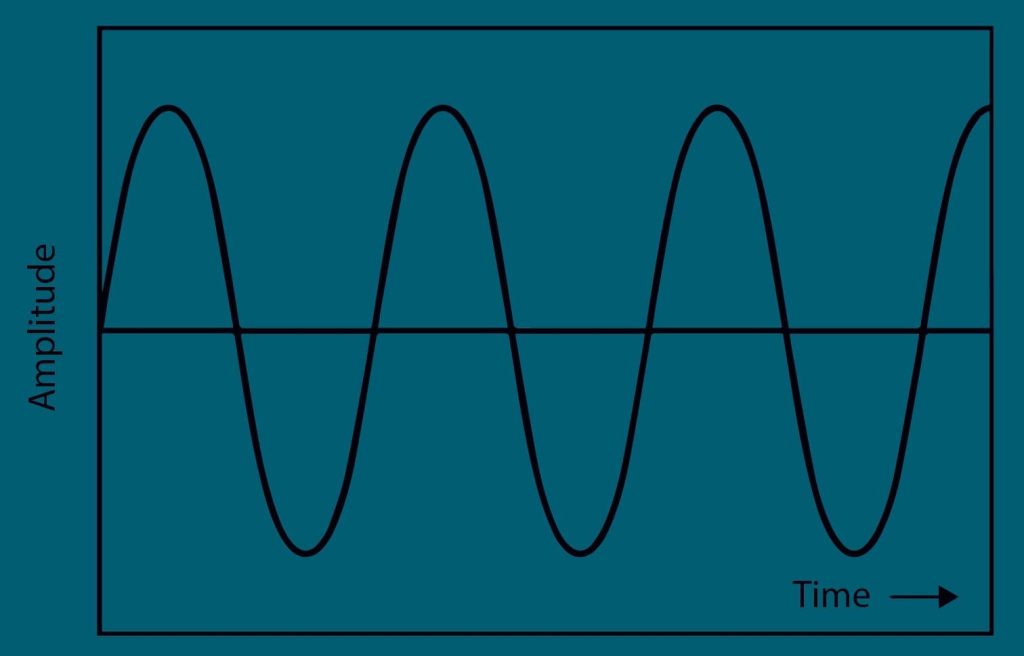
In music, phase is a temporal synchronization of audio signals. Signals are declared in phase if their waveforms oscillate at the same frequency. In the diagram below, signal 1 and signal 2 are in phase. The sound waves superimpose ideally.

Signals 1 and 2 are said to be out of phase if the waveforms are not similar. Their sound waves are said to be out of phase with each other. When the signals are out of phase, sound distortions and a decrease in power are observed. In the diagram below, signal 1 and signal 2 are out of phase.

The flanger is a phasing effect on two audio signals: the input signal and the copied signal to which a flanger is applied. The copied signal is obtained by duplicating the input signal and applying a slight delay to it. Then, the two signals are mixed, which generates cancellations of frequencies that are in opposition of phase. This is called the comb filter effect.
The changes in periodic variations in the amplitude of the frequencies create a spatial sweep effect characteristic of the flanger. It is this specificity that allows it to be identified at the slightest listening! The effect gives a very textured, sweeping and crunchy sound. It is sometimes reinforced by phase accumulations, and sometimes diminished by phase cancellations. This is what is called the “whoosh” effect, the distinctive sound that occurs when the two signals enter or exit phase.
The two effects are very similar in their design. The flanger and chorus duplicate an input signal and add a delay to it. The difference between a flanger and a chorus is in the delay applied to the copied signal. The flanger uses much shorter delays than the chorus. Likewise, the flanger only copies the input signal once, while the chorus can create one or more copies.
The flanger and chorus look very similar, especially if you don’t push the settings of a flanger to their extremes. When the settings of a flanger are adjusted correctly, the effect obtained is no longer the same as a chorus.
A basic flanger offers at least the following controls: depth (depth of modulation between the signals), rate (timing of the delay), and resonance/feedback (reflection effects). More advanced flangers offer other controls. By using depth, rate, and resonance, you already have a lot of possibilities!
The flanger reached its peak several decades ago. It could be present on an entire song without being considered too present and redundant. Today, it is much less used. When we are interested in it, it is often to enhance the timbre of an instrument during a short passage of a song.
This is clearly the most used combination for a flanger! It is also the one that we could see in the previous videos! Combining flanger and distortion is still the most common use case for a flanger today. Another example is with the introduction of Killing in the Name by Rage Against the Machine.
The combination of a flanger on percussion is generally used in electronic music to obtain a psychedelic rendering. In this context, creators often abuse pre and post-delays to accentuate the rendering. This article offers several extremely well-detailed examples.
Of course, the flanger also finds its place with other musical instruments and vocals. You have to find the right setting to give it a presence without falling into the clichés of the past, unless that’s the effect you’re looking for!
Even if the flanger is a bit out of fashion, it can still find its place on a pedalboard! There are many models on the market and many manufacturers offer at least one flanger pedal or a device that combines all the modulation effects, flanger included.
If you are looking for a specific dedicated flanger pedal, the EarthQuaker Devices Pyramids Stereo Flanging is truly exceptional! If you want to combine all the modulation effects on a single pedal effect model, then the Strymon Mobius is the right choice!
It’s hard to choose one among the plethora of options available! There are dozens of free ones that are really of excellent quality, and paid ones that offer more advanced modulations.
If we had to recommend a VST flanger plugin, it would be the Instant Flanger MK II for the precision of the depth and delay controls it offers. If you are looking for a free version, we really like the Flanger by Kilo Hearts!
The flanger, a true symbol of sonic creativity, remains a secret weapon for infusing a unique character into a musical composition. While it marked the history of rock, it continues to seduce with its versatility, whether used on saturated guitars, psychedelic percussion, or other instruments. Thanks to mastery of its parameters and modern tools, both physical and virtual, the flanger offers a captivating palette of effects.
