
Beautiful Plants For Your Interior
Beautiful Plants For Your Interior

The phaser effect, while belonging to the broad family of modulation effects, possesses a unique sonic signature that has marked numerous musical works since the 1960s. Whether through the electric guitars of rock icons like Jimi Hendrix or in the electronic compositions of Vangelis, the phaser has transcended genres and decades.
The phaser is an effect that belongs to the family of modulation effects like the chorus and flanger. It produces a swirling, sweeping, and spatial sound by combining the input signal with its own modulated version of that same signal through a phasing process.
To the ear, the phaser sounds very similar to the flanger and chorus. However, its mode of operation is significantly different! We will come back to this a little later!
Phasers have been used in music production, especially rock, since the 1960s. They first existed as an analog effect before being recreated digitally. The origins of the phaser are linked to the invention of the Uni-Vibe pedal by the Japanese Fumio Mieda. Launched in the 1960s, this pedal was quickly adopted by famous guitarists, including Jimi Hendrix and David Gilmour. The effect offered by the Uni-Vibe has been declined into different phaser pedals by different manufacturers.
The phaser has been used by a large number of artists and especially with a multitude of musical instruments. Eddie Van Halen and Jimi Hendrix used it with their electric guitars, Vangelis overused it for his synthesizer compositions, even Stevie Wonder had it integrated into some songs! Van Halen was a big fan of phaser and used it in many songs!
The name of the “phaser” effect gives clues to its operation. The phaser is an audio effect that modulates the phase of an audio signal.
To understand the principle of a phaser, it is necessary to understand the principle of the phase of a sound wave. From a physical point of view, a sound is represented by a cyclical sound wave. Sound waves are characterized by their oscillatory and periodic pattern. On the diagram below, the sound wave repeats a cyclical pattern that evolves over time according to a positive and negative amplitude.
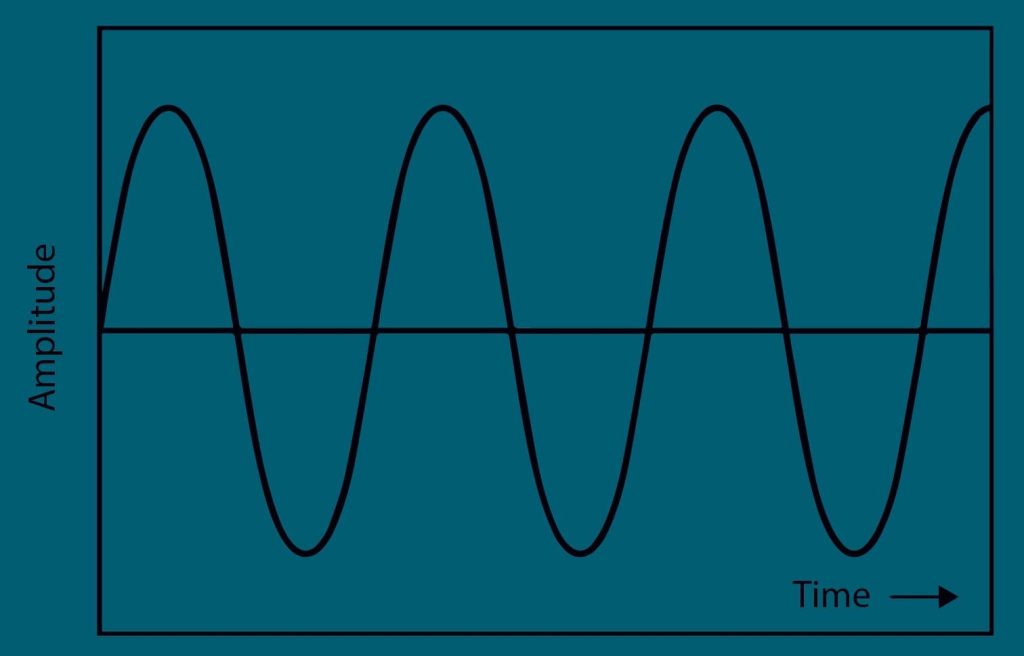
The phase represents the position of the wave at a given moment. It evolves according to the time and amplitude of the signal. It is determined by its position defined by the X and Y axes, which are the time and amplitude axes of the sound wave. The exact position of the phase is defined in degrees on the curve.
Two cumulative signals that are in phase will amplify each other, because their maximum and minimum amplitude values align (see the diagram below). Two cumulative signals that are out of phase will cancel each other out, generating destructive signal interference.

The phaser is based on phase modulation. The process involves duplicating an input signal according to certain characteristics which will transform it. All modulation effects are based on modulating the phase of the input signal, but they use different transformation characteristics.
Phasers use an all-pass filter to modify the phase between the different frequencies of the input signal and the copied signal. If you produce music, you are surely familiar with high-pass and low-pass filters. This type of filter excludes certain frequencies from the signal. The all-pass filter preserves all the frequencies of a signal, but it dephases them. A phase shift occurs when the synchronization of the maximum and minimum amplitude values of a sound wave is modified. In the diagram below, signals 1 and 2 are out of phase.

After applying a phase shift, the phaser mixes the input signal and the transformed copied signal. When two signals are no longer in phase, there are frequency cancellations. The sound wave is still there, but parts of the signal have disappeared, which produces the particular effect of the phaser. The sweep effect is achieved using a very low frequency oscillator (LFO). It is this component that generates the signal losses randomly over time.
We talked about an all-pass filter, however a phaser can use several all-pass filters in the same chain. The accumulation of all-pass filters multiplies the rendering of the effect and generates more and more complex harmonics.
Some phasers go a little further by reinjecting the transformed signal into the copied signal to create a form of spatio-temporal effect! https://www.youtube.com/embed/ZqflcjpDogI?si=Brqu1sVoe5oaYuuD
It duplicates the input signal and transforms it with all-pass filters. The phase shift of certain parts of the signals causes a distorted sound. There is no application of a delay.
It duplicates the input signal into one or more copies by modulating it and delaying it by several milliseconds (more than 25 ms).
It duplicates the input signal into a single copied signal and delays it by a few milliseconds (between 5 and 25 ms). The two signals are then mixed, which creates a kind of sweeping feedback.
All 3 effects use a low frequency oscillator (LFO) to modulate the sound. Except that this LFO does not interact with the same element. It modifies the phase for the phaser, the pitch for the chorus and the delay for the flanger. Identifying a phaser is quite complex, especially since many artists mix modulation effects between them!
Phasers have several controls:
Some phaser pedal models also have a management of the amplitude of the frequencies transformed by the phaser called width/range, or a feedback/regen control that accumulates the output signal by reinjecting it at the start of the phaser to multiply the impact of the effect.
Like most modulation effects, a phaser is placed at the end of the chain, just before the time effects (reverb and delay). Any other effect, including saturation effects and EQs, is placed upstream of a phaser. Some guitarists isolate their modulation effects using the 4-cable method so that they apply their modulation to a signal that has not been transformed by the preamp.
The phaser is used in many styles of music and with dozens of musical instruments (electric guitar, synthesizer, vocals, percussion, etc.) When using a phaser effect, you get an evolving, swirling, and airy sound. Here are a few recent examples of phaser use.
In Blinding Lights by The Weeknd, the phaser is used on synths to support the presence of the instruments.
There is a phaser on some guitars from Muse in Knights Of Cydonia. Applying the effect gives a futuristic impression to the sound! This was also Vangelis’ method of use, but on synthesizers, remember the Blade Runner soundtrack.
There are dozens of phaser pedals, but the most renowned are:
Obviously, if you had to choose one, you would go for the MXR Phase 90 which has literally made phaser history! It offers fewer settings than other models, but it remains THE essential phaser model!
Here are 5 phaser plugins to power your DAW software.
We really appreciate the possibilities offered by the Fazortan2 VST plugin! For a free solution, the Blue Cat’s Phaser or the Phaser by Kilohearts are very good phaser plugins!
The phaser is much more than just a modulation effect: it’s a true sound design tool capable of transforming an audio signal into a rich and captivating texture. From early analog models to VST plugins, this effect has constantly evolved without losing its essence. Its use by legendary artists and in modern productions demonstrates its timelessness and versatility. It’s time to experiment with it in your own compositions!

