
Beautiful Plants For Your Interior
Beautiful Plants For Your Interior

The 4-cable method (or 4CM) is a specific setup for creating effects chains using a multi-effects processor or several small effects pedals. As the name suggests, it is a configuration that is achieved using 4 cables. It allows you to isolate a part of an effects chain in order to include it in an effects loop. Its operation allows the isolation of a part of the signal through different sections of your amplifier. The purpose of the 4-cable method is to separate certain effects from the main audio signal to obtain a more harmonious and rich final signal. It is a technique that has become popular with musicians over time because of the sonic possibilities it offers.
The 4-cable method allows you to create effects chains from your pedalboard or effects processor in the way you are used to, while isolating a part of the signal so that it can benefit from the advantages of your amplifier to generate different tones. In general, guitarists direct the signal from certain effects to the effects loop in order to produce a more natural sound. This is particularly true for time-based effects such as delay and reverb, but also for some modulation effects such as phaser and chorus. By isolating these effects, they can be placed after the preamp. Indeed, some effects react quite badly by producing strange sounds depending on their position in an effects chain. Unless you are looking for a particular sound, you would never place a delay or reverb before a distortion. Otherwise, the distortion gets lost among the time-based effects and the result becomes uncontrollable.
The primary benefit of the 4-cable method lies in its ability to seamlessly blend post-preamp signals with other effects. This configuration grants precise control over the sonic shaping of your effects chain. By isolating time-based effects and placing them within the effects loop, you can fully utilize the equalizer and distortion capabilities of your preamp without compromising their intended effects. The 4-cable method empowers you to meticulously route your signal and unleash a vast array of sonic possibilities.
For electric guitarists, the 4-cable method often serves as a tool to harness the distortion settings offered by their preamp. By isolating “saturation-averse” effects within the effects loop, one can maximize the utilization of the preamp’s distortion capabilities. This approach allows for a more dynamic and nuanced distortion experience, preserving the integrity of other effects while leveraging the preamp’s inherent tonal characteristics.
To embark on the 4-cable method journey, you’ll need the following essential equipment:
In today’s music industry, the majority of quality amplifiers and multi-effects processors come standard with a Send & Return system. It has become somewhat of an industry norm. Only entry-level or older generation models might lack this feature.
An effects loop is represented by an additional jack input and output on your devices. Note that these are in addition to the traditional Input (instrument and signal input) and Output (signal output) jacks. The connectors of an effects loop are typically labeled: FX send, FX out, Effect send, Effect out, or FX in, FX out, etc., depending on the brand of your device. The effects loop allows you to route the signal between the two main parts of an amplifier: the preamp and the power amp.
The preamp receives, adapts, and enhances the signal it receives before sending it to the power amp, which amplifies it to make it audible. A preamp plays a real role in the signal processing and has equalization knobs on the amplifier. While the power amp plays the role of the sound projector using the speakers. With the 4-cable method, it is possible to split the signal between the preamp and the power amp. The effects loop is located between the preamp and the power amp. By using the 4-cable method, you will place a certain part of the signal before the preamp. For example, on Line 6 effects processors, the jacks are named SEND and RETURN IN. So there is a signal input and output jack.
A wide range of effects processors and amplifiers are compatible with the 4-cable method. However, you won’t find compatibility in entry-level models. You’ll need to invest a few hundred euros to access ranges with loop systems.
Line 6’s Helix, Pod GO, and HX (HX Stomp, Helix LT, HX Stomp XL, Pod GO, etc.) ranges are equipped with a loop system. At Boss, all mid-range and high-end processors are equipped with a Send & Return (GT-1000, GX-100, ME-90, etc.). For Hotone Audio, you’ll need to look at the Ampero Series II. You can have a look on the Ampero II Stomp and the Ampero II Stage. Be careful with the Zoom brand, many of whose processors are very limiting in terms of settings! Many of them do not have an effects loop. You have to go for the top of the range of their processors. Finally, there are the HeadRush processors which are a little less known, but whose quality is there! Here are 3 models, equipped with a Send/Return effects loop, that we particularly like.
There are so many amps on the market that it would be difficult to list them all. Simply check if it has ‘Send & Return’ jacks.
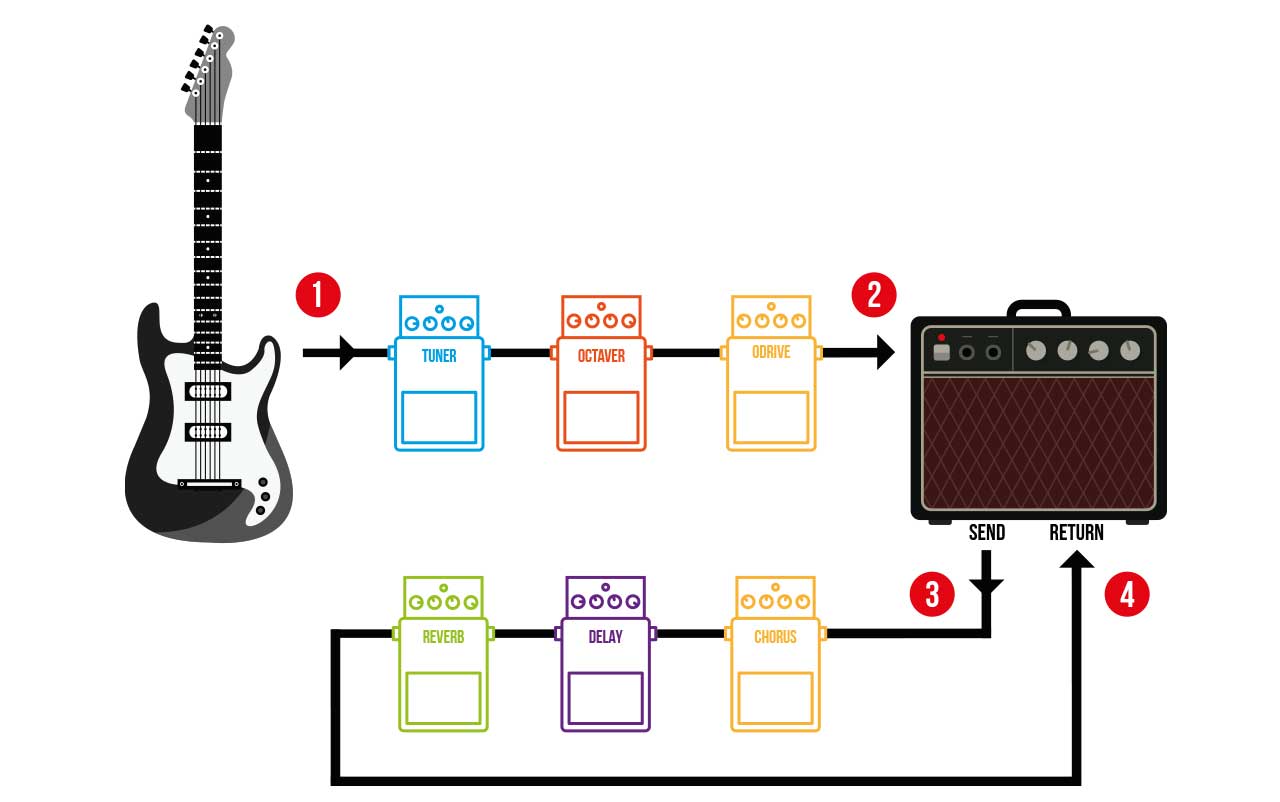
With an effects processor, the rest of the setup is done electronically inside the effects processor. It is necessary to check that your effects chains have ‘Send‘ and ‘Return‘ modules. In the case of some effects processors, it is also necessary to activate the effects loop.
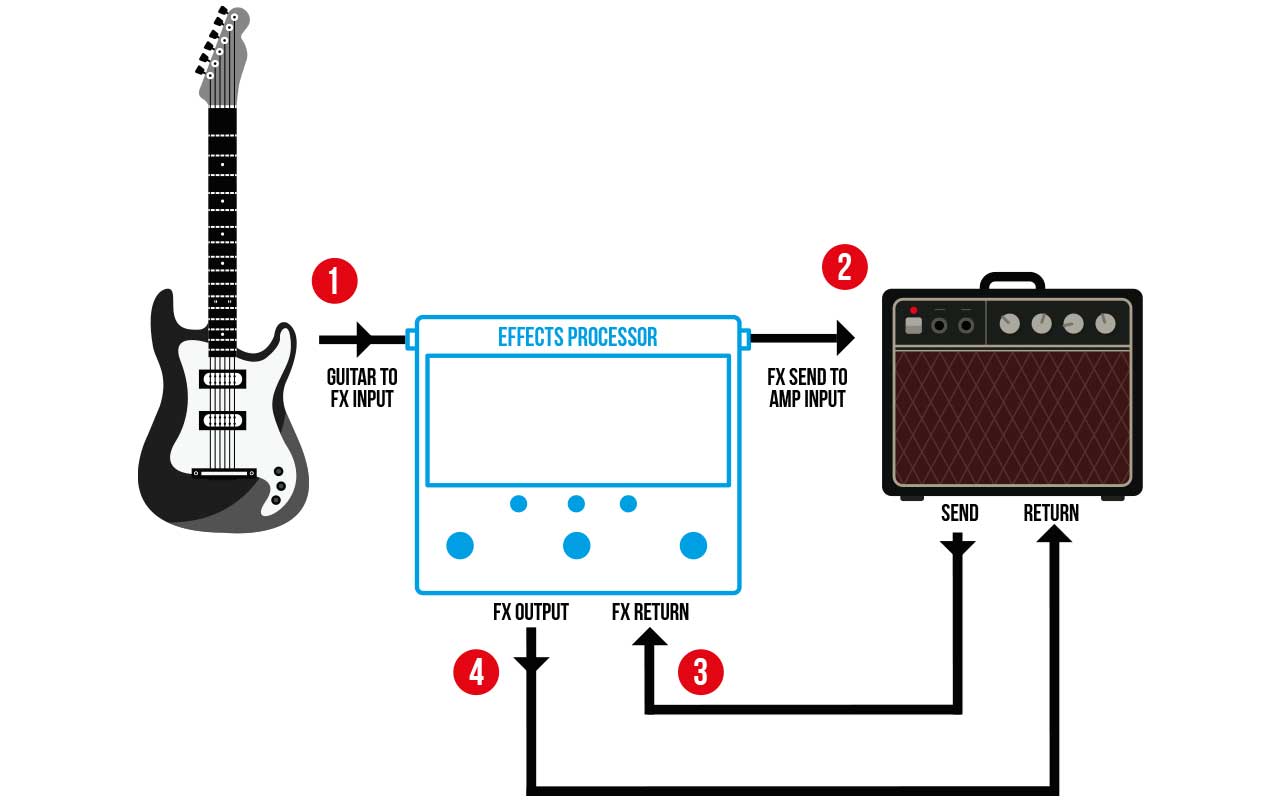
Now that you’re familiar with the connections, let’s delve into the journey of the audio signal through all these components.
In general, pedals that play a significant role in shaping the sound, such as saturation pedals(overdrive, fuzz, distortion), compressors, and wah pedals, are placed before the preamp and therefore before the effects loop. The preamp will influence the sound of these preceding effects. Then, the effects loop will isolate time-based effects so that they are not influenced by the preamp settings. Modulation effects like chorus, phaser, flanger, and tremolo can also be placed in the loop.
Like many innovations in guitar effects, the 4-cable method emerged with the advent of high-gain guitar amplifiers in the 1980s. Guitarists wanted to generate heavy saturation while preserving their time-based effects by limiting their compression. To achieve this, they used two separate devices: a preamp and a power amp, which allowed them to position their effects freely. However, modern amps are equipped with a preamp and a power amp, making this approach impossible. To address this limitation, manufacturers developed and integrated an effects loop system into amplifiers. The position of effects in a signal chain determines the final result. The addition of each effect influences the sonic outcome. For instance, the placement of a delay or compressor will produce different sounds depending on whether it is placed before or after an overdrive pedal. This is further complicated by the natural distortion produced by amps. As the gain is increased on an amp, more compression is generated. This compression is the source of the sustain produced by an amplifier, which is highly valued by guitarists. Unfortunately, this compression can be detrimental to other effects that, if placed before the preamp, will be subjected to compression levels that make them inaudible. That’s why amp makers created the effects loop and the 4C Method.

