
Beautiful Plants For Your Interior
Beautiful Plants For Your Interior
Do you know the story of the wah pedal? You’ve probably heard it in one of the many rock tracks it embellishes or seen Jimmy Hendrix use it in one of the videos available on YouTube. This effect completely transforms the sound of a guitar, and when used well, it’s literally a banger effect! Let’s discover together the whole story, and especially the accident that led to the creation of the wah and its massive use by the greatest musicians.
The Thomas Organ company then deployed a promotional arsenal to promote its pedals.
The wah, also known as the wah pedal, is a device generally used with electric guitars. It modulates the sound of the musical instrument into a sort of human voice pronouncing the syllable “wah.” The “wah” sound occurs due to the foot rocking back and forth on the pedal.
It enjoyed its glory days thanks to its use by Jimmy Hendrix! It adorned his pedalboard at all his concerts! He standardized its use, influencing many musicians who adopted his style and then defined their own!
The first instruments to produce a “wah” effect were not guitars. It was trumpets that produced it first. It comes from a small object used on wind instruments: the mute. It’s a device used by brass instruments to reduce and modify the timbre and volume of the instrument. Mutes are held in one hand and inserted into the bell of the instrument. Some are clip-on or attached to the bell.
The benefit of the mute in producing the “wah” effect is that it fits snugly into the bell. It has a small central hole through which a cylindrical tube with a bell end moves. The sound changes depending on the position of the tube. By adjusting the opening of the tube with the hand, the musician generates a “wah” effect. The “wah” effect is associated with trumpeter Clyde McCoy. He generated different sounds using his trumpet and a mute.
With the arrival of the first electric guitars, guitarists sought new ways to expand the tonal and sonic range of their instruments. The very first wah pedal was born out of an accident! Let’s recall the context of its creation!
While the Beatles were experiencing wild success in Britain, they faced limitations with their Vox amplifiers. The British company Jennings Musical Industries produced the Vox AC-30 amplifiers. These 30-watt amplifiers were among the most used by musicians. Unfortunately, a 30-watt amp becomes barely audible against a horde of screaming fans! To remedy this issue, Jennings Musical Industries launched a new 100-watt amplifier called the “Vox Super Beatle Amplifier”! It was first used during the Beatles’ televised debut on the American show Ed Sullivan Show in 1964. It gathered 73 million Americans in front of their TVs. This massive visibility launched the Beatles’ popularity among Americans, but also indirectly that of Vox amplifiers!
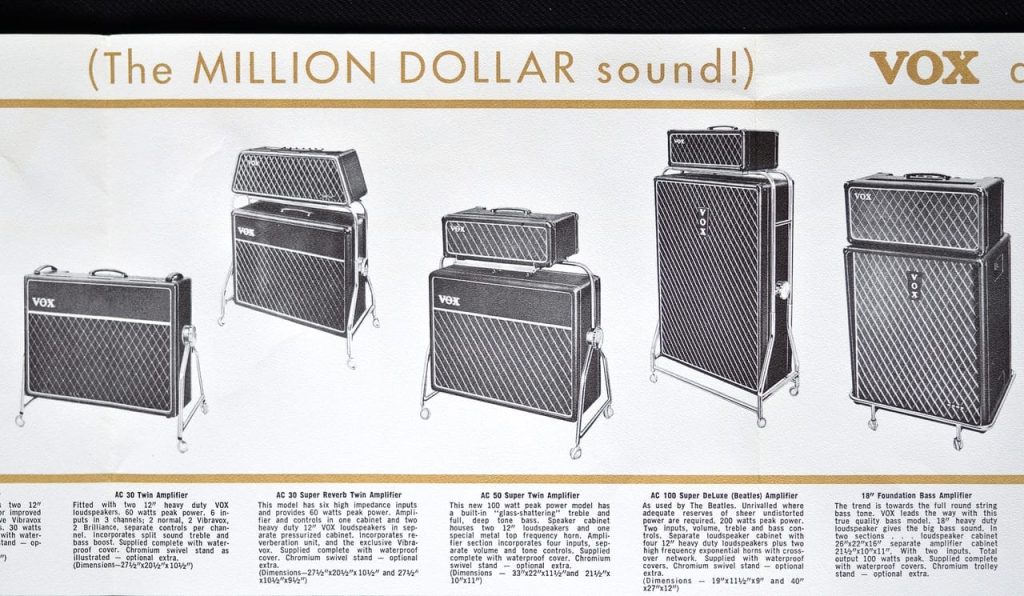
I’ve never understood whether the amplifier’s name was “Vox Super Beatle Amplifier” or “Vox Super Beatles Amplifier”! Some documents name it one way or the other.
Jennings Musical Industries realized there was a market to seize with their amplifiers! Without a local presence and unable to manage imports and exports alone, they partnered with the California-based company Thomas Organ to distribute their amps. Quickly, the two companies realized that import-export wasn’t the solution. The costs were far too high to ensure good profitability! Thomas Organ then struck a deal to manufacture and distribute Vox amplifiers in the United States.
By 1965, Thomas Organ began manufacturing Vox amplifiers in California. The company was searching for the best balance between sound quality and production costs. Its engineers were exploring new technologies to reduce production costs. Among them, Brad Plunkett was analyzing the “MRB” or “Middle Range Boost.” It was a small switch designed to boost the instrument’s midrange frequencies. In his quest to reduce costs, Brad Plunkett realized it was possible to replace this switch with a simple potentiometer linked to a circuit. The result was identical, but production costs decreased!
During tests with his guitarist friend John McGlennon, he noticed that when playing while turning the potentiometer, strange “wah-wah” effects were produced! The wah effect was born!
Unfortunately, one question remained: how could a guitarist turn the potentiometer while strumming the guitar strings? Brad Plunkett still needed to work on the physical aspect of his device! He searched for a solution and dismantled a volume pedal used on Vox electric organs. He reused the mechanism of the pedal, incorporating his potentiometer and electronic circuit. The potentiometer was now controlled by the foot!
In the 1960s, guitarists didn’t have access to as many effect pedals as they do today. There were tape delays, tremolos, a few spring reverbs, and some overdrives (fuzz). Guitarists were very eager for novelties that could transform their sound and tone!
There are small controversies in the history of the wah, with slightly different versions between engineer Brad Plunkett and guitarist Del Casher. The latter was a Vox brand ambassador in the United States. He was a studio guitarist for other artists. At the same time, he collaborated with Thomas Organ in developing certain products. That’s how he discovered the first wah pedal.
Initially, Joe Benaron, the president of Thomas Organ, was convinced that this effect should be intended for wind instruments, not electric guitars! Del Casher completely disagreed! He decided to make a promotional recording with the new pedal. He demonstrated the potential of the wah on several tracks from different genres! His recordings convinced Joe Benaron of the wah’s huge potential for guitarists.
Thomas Organ then launched a major advertising campaign to promote its pedals.
Two wah pedals were released to the market: The Vox ‘wah-wah’ Clyde McCoy (soon replaced by the name ‘Vox wah-wah’ to avoid limiting it to wind instruments) and the Crybaby. The latter was named “Crybaby” because the effect resembled a baby crying!
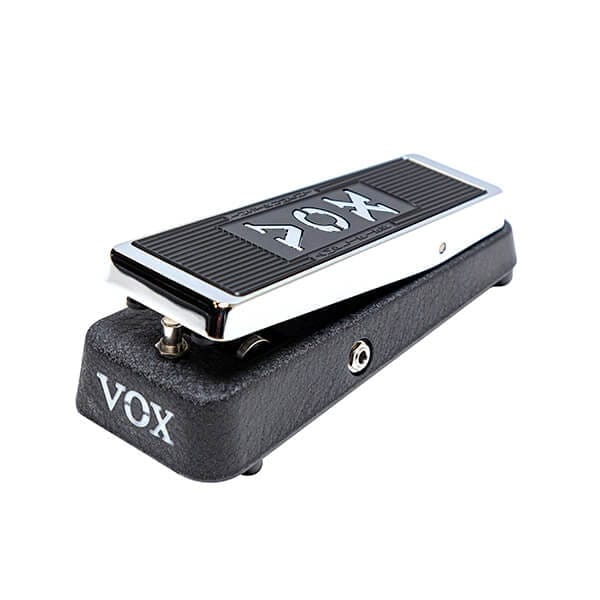
Its presentation of the Crybaby was clear:
You can make your guitar growl with the Crybaby. These and many indescribable groovy sounds are possible with the Crybaby.
Both pedals were manufactured by Thomas Organ. There were two models; Thomas Organ sought to free itself contractually from Vox.
Thomas Organ took some time to realize the invention they had created! They decided to patent it late, by which time the wah pedal had already been showcased and adopted by guitarists. Its production was moved to Italy. There, the very workings of the wah were copied and reproduced by dozens of other manufacturers! This made the wah pedal even more popular, but it was also a huge loss for Thomas Organ.
The success of the wah pedals was almost immediate! The wah effect can be heard in numerous studio and live recordings! All guitarists added it to their pedalboards: Frank Zappa, Jimmy Hendrix, Eric Clapton, Jimmy Page, etc.
Many electric guitar solos using a wah pedal appeared in the mid-1960s, such as Hendrix’s Up From the Sky or Cream’s Tales of Brave Ulysses. Jimmy Hendrix is recognized as one of the main users and promoters of the wah pedal. He adopted the pedal on many tracks! One famous example is Voodoo Chile (Slight Return), probably the most well-known wah track! There are many video recordings of Jimmy Hendrix playing with a wah pedal.
The wah had found its place in rock! But it also became prominent in other musical genres like funk, blues, jazz, and soul. For example, Earl Hooker’s Wah Wah Blues released in 1969, and the funk theme from Isaac Hayes’ film Shaft.
Since the early 1990s, the wah has been less present! Its distinctive sound has become somewhat outdated and has been relegated to an older style. Many guitarists own a wah pedal, but it is heard less frequently in recordings. While in the past, the wah could adorn an entire track, today it is used sparingly for just a few seconds of a song. It is placed in an introduction to differentiate it from the rest of the track or to energize the rhythm of the chorus, for example.
Its use is much more subtle! However, it has not been forgotten! Many bands have incorporated it into their tracks, including Guns N’ Roses, Pearl Jam, and Muse.
We also recommend watching the documentary Cry Baby: The Pedal that Rocks the World! It summarizes both the history of the wah pedal and its adoption by guitarists!
Many manufacturers have entered the market (Boss, Hotone, Ibanez, Mooer, etc.) Wah pedals are difficult to evolve today! Some manufacturers have combined wah pedals with expression pedals, while others have integrated a booster or even a tuner to stand out. These options are interesting, but they are not essential! What is expected from a wah pedal is to produce the wah effect, and not much more! If we had to choose just one model, we would opt for a Dunlop Crybaby or a Vox Wah Wah.
It is essential! When Thomas Organ went bankrupt, it was Dunlop who acquired the patent and the original models of the first wah pedals. This company brought wah pedals back into fashion! Today, there are dozens of Dunlop Crybaby models with small specificities that differentiate them (the Q, the filter band, wah modes, etc.).
The Vox Wah-Wah is still on the market! It has obviously evolved over the decades.
Wah pedals have a different appearance from other effect pedals. They feature a rocking pedal that moves back and forth under the musician’s foot. This movement controls a filter that amplifies a part of the spectrum produced by the guitar or any other musical instrument. By moving the foot, the musician varies the center frequency! The frequencies increase and decrease according to the position of the rocking pedal. The wah pedal produces a dynamic and evolving effect by generating the ‘wah’ sound reminiscent of a human voice.
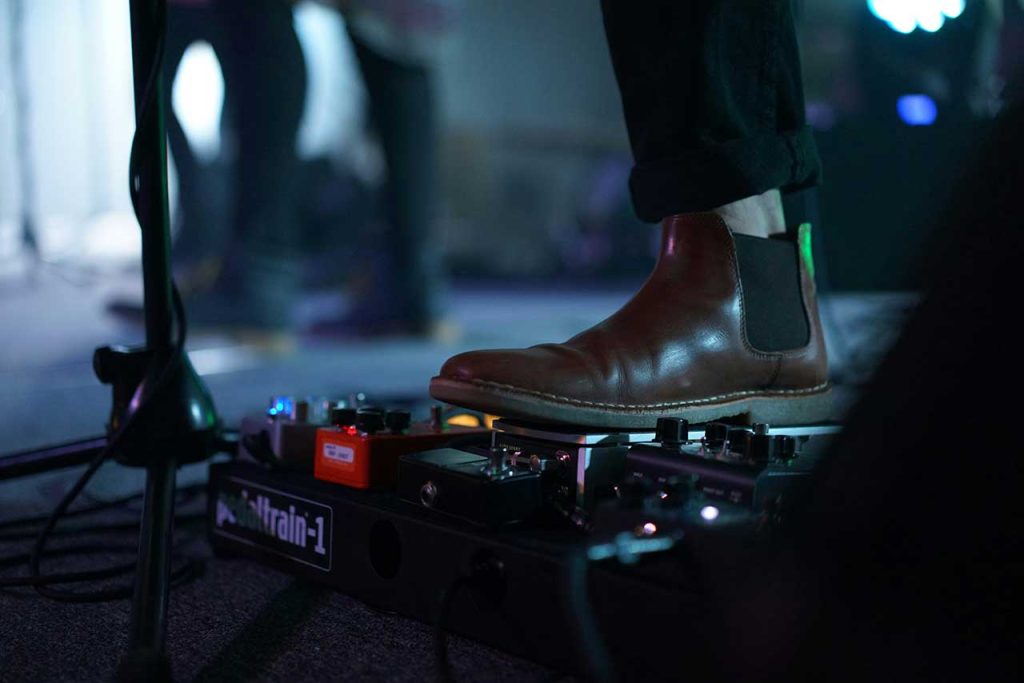
The wah pedal is placed at the beginning of the chain, so first! Wah pedals are tone filters. To fully benefit from their power, they need the maximum amount of frequencies. This is why most musicians position it right after the guitar or any other musical instrument.
However, as we remind in every article, there are no rules regarding the placement and position of effect pedals! Don’t hesitate to experiment to create new sounds! Creating an effect necessarily involves testing!
The sound of a wah pedal depends a lot on the instrument used. Depending on the richness of the harmonics, the sound can be very different. We are used to hearing it in guitar tracks, but it is also used by cellists, violinists, keyboardists, and bassists.
It doesn’t have the same sound depending on the instruments! Simply because they are physically different from each other! For example, the guitar sustains notes less than a string instrument with a bow! Bowing is a real plus for a wah pedal!
What about the experiments of trumpeter Miles Davis with his trumpet filtered through a wah pedal on the album Bitches Brew!
Its use depends on the style you want to give! Is it to accompany an instrument or the voice? To transform the rhythmic foundation? To perform a solo?
The wah pedal is often combined with other effects in a powerful effects chain. It is rare for it to be used alone without any other effect around! It takes on its full value when paired with other effects to which it adds an additional layer. Jimmy Hendrix combined it with saturation effects like distortion and fuzz.
Born from a happy technical accident, the wah-wah pedal has become an indispensable tool in the history of modern music. Adopted by legends such as Jimi Hendrix, it marked the golden age of rock, funk, and other musical genres. Although its use has evolved over the decades, from an ubiquitous effect to a much more subtle sonic ornament, the wah remains timeless! It is one of the symbols of musical expression.
