
Beautiful Plants For Your Interior
Beautiful Plants For Your Interior
The modern shape of the guitar originates from significant developments in Spain during the 17th century, evolving from ancient musical instruments. Guitars have transformed over the centuries until the 19th century, when their designs and dimensions became standardized. Let’s discover 10 acoustic and electric guitars that have left their mark on the history of music!
Antonio de Torres, a famous Spanish luthier, is behind the traditional shape and dimensions of the so-called “classical” guitar. Then, luthiers Christian Frederick Martin, whose history and creation of Martin guitars we have discussed, and Orville Gibson, founder of Gibson guitars, contributed to further developments of guitars.
The family-owned company C.F. Martin & Co, founded by Christian Frederick Martin, envisioned a range of dreadnought guitars, also known as folk guitars. The creation of this model was driven by the needs of musicians at that time. Amplification was not yet accessible, and guitarists sought a guitar capable of withstanding the competition from instruments like trumpets. The dreadnought changed the game with its large size, longer scale length, and the use of metal strings. The dreadnought shape has since become a standard guitar model. This first evolution allowed the guitar to thrive on non-amplified stages.
The electric guitar didn’t emerge until the 1930s. The origins of the electric guitar are a subject of much debate. It was born in the United States by several pioneers, including Llyod Loar in partnership with Gibson, Leo Fender, and Les Paul. The invention of the electric guitar was only made possible by the technological advancement of pickups. These small devices can transform string vibrations into an electrical signal sent to amplifiers or speakers. Without the pickup, the guitar would never have taken center stage!
The electric guitar has undergone several physical evolutions, with bodies featuring hollow bodies and solid bodies. The first solid body was launched by Leo Fender on his famous Fender Broadcaster, later known as the Fender Telecaster.
The electric guitar was adopted by many guitarists in the 1950s. It gave rise to new musical genres like rock!
We have chosen 10 legendary guitars among the hundreds of models that exist or have existed. They are still produced by their manufacturers! Of course, they have undergone evolutionary changes linked to new inventions and technologies.
Launched in the early 1920s, the Gibson L5 was invented by luthier Lloyd Loar. He worked for Gibson between 1919 and 1924. The Gibson L5 has never ceased production since its launch, except during World War II, when the war effort did not allow for the manufacture of musical instruments. It is the very first model to feature “f” holes inspired by violins and other bowed acoustic string instruments. The L5 was initially 100% acoustic, then it was electrified in the 1950s. The Gibson L5 left its mark on the country music genre.
There are several models of Martin guitars in the 28 style: D-28, OM-28, or 000-28. They have marked the history of C.F. Martin & Co and are still references for the brand. The Martin 28-Style guitars are recognized for the quality of materials used and their perfect assembly! They offer a balanced and rich sound, with a certain versatility for any musical genre with the OM-28. The Martin OM-28 has been played by many guitarists like John Mayer. We chose the OM-28 because we had never mentioned it on this site until today. The HD-28, D-45, and D-18 models have their own IR files.
The design of the National Duolian is recognizable among a thousand guitars! It is the work of American luthier John Dopeyra. Created at a time when guitarists were content to accompany more powerful instruments, it has a larger body and features a resonator that acts as an amplifier! The latter offered a sound presence unmatched by other guitars. It was highly appreciated by blues guitarists.
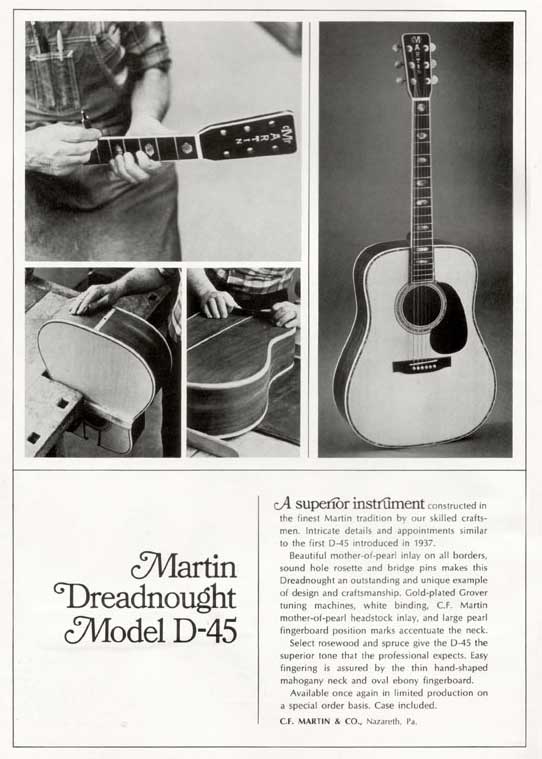
The Martin D-45 is one of the high-end models in the Martin guitar collections. It was launched in 1933 and is one of the most accomplished models in terms of sound, playability, and durability. It features the famous X-bracing invented by C.F. Martin & Co to offer a wide resonance and sound projection. The legend of the D-45 lies in its tone and thanks to the many guitarists who adopted it: Johnny Cash, Neil Young, or John Mayer. We have created an impulse response of the Martin D-45!
The Fender Telecaster is a famous model of electric guitar launched in 1952 by the Fender brand. It has a very specific shape and features a pickup selector for three different tones. Vibrations can be picked up at the bridge, neck, or a blend of the previous two pickups. For the record, the Fender Telecaster was initially named the Fender Broadcaster. But the term was already used by the manufacturer Gretch, which offered the Les Gretch Broadkaster guitar. The Fender company then changed the name to Telecaster. The Telecaster has undergone small improvements, mainly related to technological advances and generational adaptations.
The Fender Stratocaster was launched in April 1954, following the Telecaster. It is also commonly called the Strat! Its design is one of the most famous for electric guitars! It has clearly become an iconic model! It is an evolution of the Telecaster following feedback from musicians. Its shape did not follow traditional curves, which could have been fatal! To avoid this issue, Leo Fender was accompanied by many musicians to validate this new shape. It was also one of the first models equipped with a vibrato. It has only slightly evolved since its launch.
It is probably one of the most famous guitars offered by the manufacturer Gretsh. The White Falcon model is entirely lacquered in white paint with gold hardware, giving it an iconic appearance. This combination seems simple today. Yet, remember that in 1955, guitars featured traditional shapes and similar colors (natural wood or tobacco color with possibly a sunburst). Look at it and imagine yourself in 1955, faced with this splendid guitar that stood out from all the others! It was called “the guitar of the future”! The number of guitarists who have played it is staggering: Neil Young, Eric Clapton, Elvis Presley, Jeff Beck, and many others.
The Rickenbacker 325, produced by the American company Rickenbacker, was put in the spotlight with the rise of the Beatles. Indeed, John Lennon, a member of the group, owned a Rickenbacker 325 Capri to which he had added a Bigsby vibrato. He had bought it in Germany in the early 1960s before the group’s popularity. The Beatles’ recognition propelled the production of the Rickenbacker 325.
The Epiphone company was created by Anastasios Stathopoulos in 1870, first in Turkey, then relocated when its founder immigrated to the United States in 1903. It produced numerous guitars, trying to stay competitive against Gibson, in particular. Epiphone was acquired by Gibson in 1957, which revived the brand by unveiling new models, including the Epiphone Casino. They were or inspired many existing Gibson models. The Epiphone Casino was adopted by several members of the Beatles, which propelled the guitar onto the international market. This guitar model has passed through the hands of many guitarists, such as Paul McCartney, John Lennon (The Beatles), Keith Richards (The Rolling Stones), or Dave Davies (The Kinks).
