
Beautiful Plants For Your Interior
Beautiful Plants For Your Interior
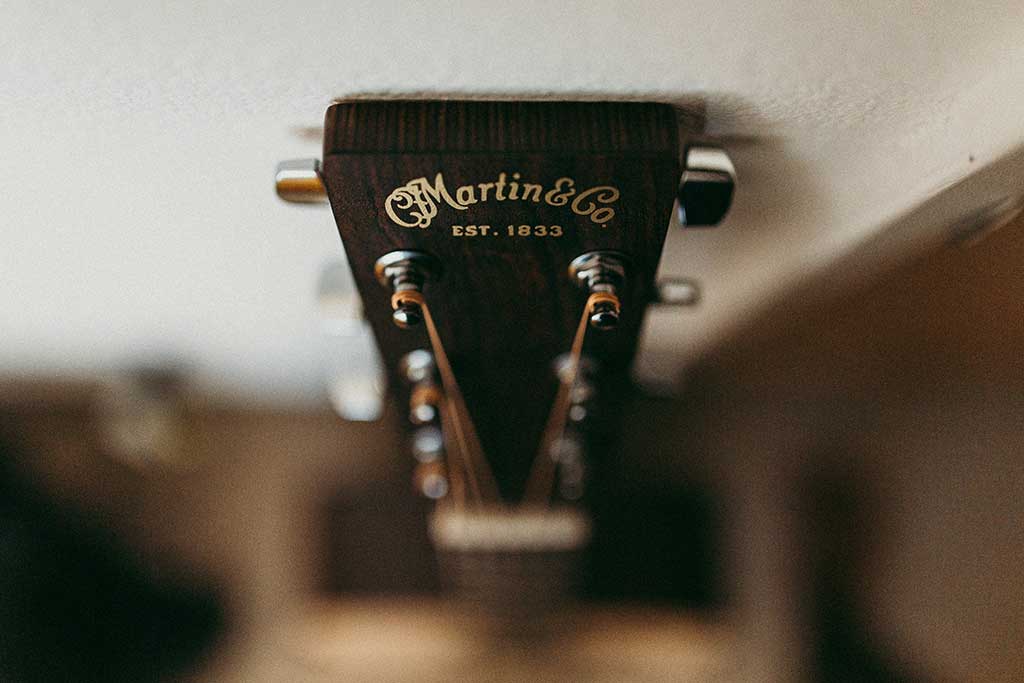
Discover the legacy behind Martin guitars, revered globally as the pinnacle of acoustic craftsmanship. Explore the rich history of C.F. Martin & Co., spanning nearly two centuries of innovation and tradition. From humble beginnings to iconic dreadnought designs, delve into the evolution of these legendary instruments. Martin acoustic guitars have gained international renown, making it one of the most recognized guitar brands worldwide. For many guitarists, owning a Martin guitar represents a real achievement.
The Martin company has always focused on a very specific goal: crafting high-quality acoustic guitars. The company has never wavered from its intentions and has adapted to numerous musical movements. Over the years, Martin has introduced new guitar models in response to evolving musical styles.
Today, when people talk about guitars, names like Gibson and Fender often come up. However, neither of these brands boasts the centuries of experience held by C.F. Martin & Company.
The company has remained in the hands of the same family throughout its history, passing down its expertise through generations.
In modern times, C.F. Martin & Company produces acoustic guitars and ukuleles. Martin acoustic folk guitars are among the most famous and have made a significant mark on the history of guitars. Throughout its history, the company has also manufactured mandolins, basses, and a few electric guitars.
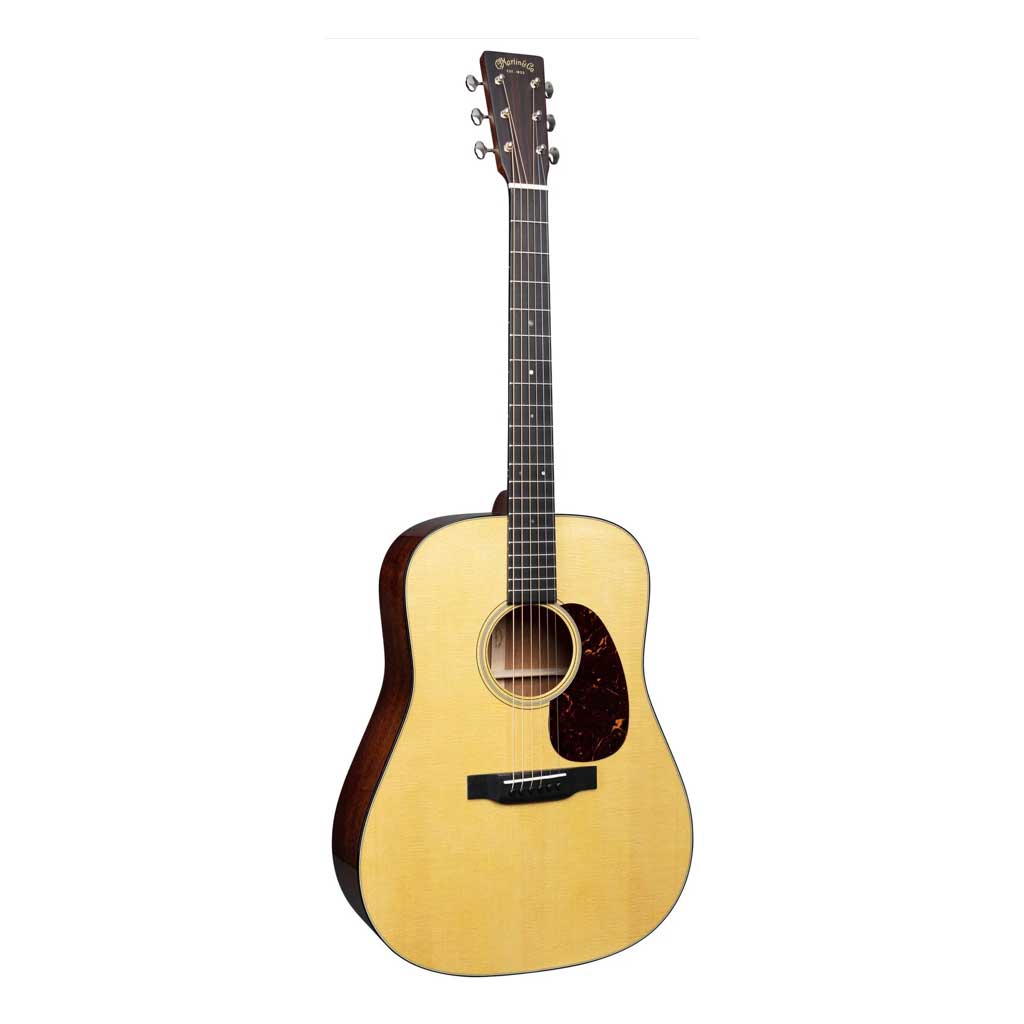
C.F. Martin & Company has been manufacturing acoustic guitars for almost two centuries. Initially established in New York and now based in Pennsylvania, the company was founded by German immigrant Christian Friedrich Martin in 1833.
Born in Markneukirchen in 1796, Christian Friedrich received classical lutherie training from the Austrian luthier Christian Stauffer. After completing his apprenticeship, he returned to Germany and started making guitars, but soon encountered industrial difficulties. At that time, in Germany, trades were organized into guild systems, where each trade was authorized to manufacture certain elements. There was a dispute between cabinetmakers and luthiers over the rights to guitar manufacturing.
Tired of these disputes, despite his guild winning, he chose to immigrate to the United States to open his first shop in New York.

Initially, Christian Friedrich’s early guitars adhered to the teachings he received in Austria: guitar head with all tuning keys on one side, curved bridge, adjustable neck length, and so on. When he left New York to settle in Pennsylvania, Christian Friedrich modified his guitars, thus laying the groundwork for the Martin style. He notably transformed the bracing system.
Bracing refers to a set of “large veins” positioned under the soundboard to withstand the tension of the strings, facilitate the propagation of sound waves, and improve the sound quality of the acoustic instrument. The bracing of an acoustic guitar consists of wooden struts fixed under its soundboard. They provide structural support, but more importantly, they determine the degree of vibrations received by the soundboard, shaping the sound of an acoustic guitar. You can see below an example of a Martin bracing.

Christian Friedrich envisioned the X-bracing system that characterizes the distinctive sound of Martin guitars. This system was initially criticized by purists who favored the fan bracing system. However, it later became an advantage with the introduction of steel strings, which imposed greater tension on the instrument’s body. The X-bracing system proved to be much more resistant to the pressure exerted by these strings, giving C.F. Martin & Company a significant advantage.
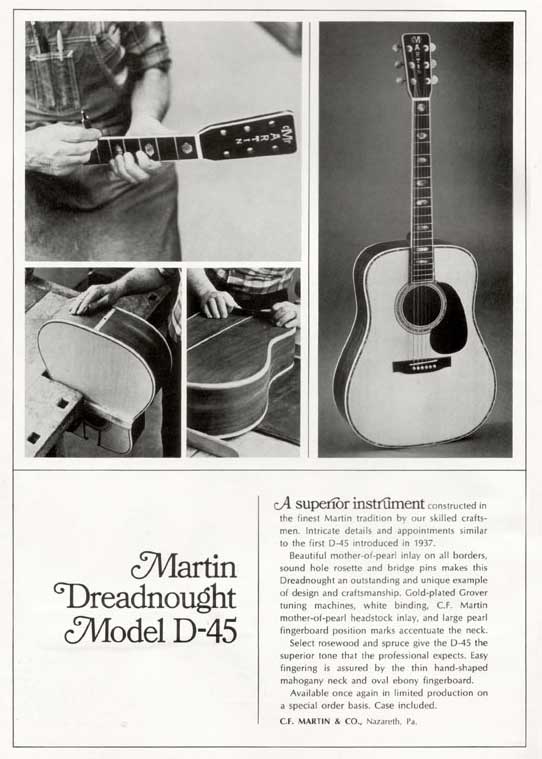
The dreadnought guitar is a very particular design of acoustic guitar invented in 1916 by Frank Henry Martin, one of Christian Friedrich’s descendants. This style was later adopted by dozens of guitar manufacturers. The dreadnought model features a large soundboard, a large size, the traditional X-bracing, and a powerful sound with deep bass. Today, the dreadnought is the most commonly used folk guitar shape worldwide. Below is the Martin dreadnought D-45 model, promoted in an old advertisement from the 1930s.
Like many instruments, the dreadnought guitar was born out of significant developments in music. At that time, there were no electric instruments, so acoustic guitars needed to be audible alongside wind or percussion instruments. A guitar mixed with these instruments on stage was difficult to hear. Frank Henry Martin thus conceived a guitar with a larger size and a longer scale length to increase its volume. Previously, the neck was attached to the 12th fret. On this model, it is attached to the 14th fret.
We could say that the dreadnought guitar shape is the stratocaster of acoustic guitars!
C.F. Martin & Company has won the hearts of the greatest guitarists across all musical genres. Most of the guitar legends have played or currently play a Martin guitar. This includes Bob Dylan, Johnny Cash, Joan Baez, Jimmy Page, and even Elvis Presley. In the 1990s, Kurt Cobain played a Martin guitar during the recording of the famous MTV Unplugged live album. Today, among the most famous guitarists playing a Martin guitar, are Ed Sheeran, Sam Hunt, and Eric Clapton. Read our comparison of iconic martin guitars.

