
Beautiful Plants For Your Interior
Beautiful Plants For Your Interior

The original guitar uses 6 strings! Over time, with inventions and the needs of musicians, it can now have many more strings. The addition of extra strings multiplies the tonal possibilities offered by the instrument to its player. Most musical genres have embraced this type of instrument! It’s safe to say that 7- and 8-string guitars have delighted rock and metal guitarists. Let’s discover how guitars with more than 6 strings appeared and how they found their audience!
One might think that the origins of guitars with more than 6 strings are recent! However, this type of guitar was born many decades ago. Adding strings to musical instruments is not a new phenomenon. Almost all musical instruments have versions with more strings than the basic instrument! This is true for guitars, ukuleles, violins, double basses, or cellos! These inventions often stem from experiments carried out by seasoned musicians and luthiers. Their intention is often to meet a need or imagine something new!
Guitars with more than 6 strings appeared at the beginning of the 19th century. For example, there is the Russian guitar, also called the Russian guitar (or Gypsy guitar), which has 7 strings. It dates back to the late 18th century and is similar to the traditional Spanish classical guitar. 7-string guitars are far more common than 8-string guitars. Watch below an example of 10-string guitar.
In the history of 8-string guitars, references are often made to guitarist-composers Luigi Legnani and Giulio Regondi, who played this type of instrument at 19th century. At that time, there were numerous guitars with more than 6 strings, sometimes up to 10 strings. They were played during performances of classical, traditional, or folk music. Their goal was to extend the range of these instruments by offering musicians a broader tonal palette. Some of these guitars had underlying sympathetic strings that resonated based on the vibrations produced by the other strings. Notably, the “Decacorde” a variant of the guitar imagined by Ferdinando Carulli, had such features. He developed a 10-string guitar. He even wrote a “Method for the Decacorde” specifically dedicated to this instrument.
The major challenge in adding strings to acoustic guitars is maintaining the structure of the instrument. The essential elements of the guitar must withstand the tension imposed by the strings. The neck and the soundboard must not move! The resonance must also be in line with the new strings! The sound projection and intonation must be sufficient to convince musicians!
There are folk and classical guitars with 7, 8, 9, or even 12 strings! Sometimes all the strings are playable, sometimes they are sympathetic strings that resonate when the playable strings vibrate.
The Brahms guitar is an 8-string guitar with a traditional hollow body and an external resonator placed at the musician’s feet. It is also called the guitar-cello due to the way it is played. The musician positions it like a cello, thanks to its spike that connects the bottom of the instrument to its resonator. The Brahms guitar was invented in 1994 by luthier David Rubio and guitarist Paul Galbraith. The making of this guitar required adaptations to make it playable. It uses two additional strings: a low A and a high A, resulting in AEADGBEA tuning. The frets are positioned differently, with a specific angle to accommodate different string lengths (scale length).
In jazz, there is always reference to guitarist George Van Eps. He played a 7-string guitar made by Epiphone in the 1930s and later 7-string Gretsch guitars in the late 1960s. His first 7-string model used a bass string in addition to the traditional 6 guitar strings. This string allowed him to play bass lines below his own chords, a technique that was quite different from what had been done up until then.
Dozens of other guitarists followed suit, such as Ron Eschete, John Pizzarelli, and Lenny Breau. The latter was one of the few to adopt a high A string (tuned above the high E of a guitar). Since no manufacturer offered a string capable of withstanding such tension, he installed a sufficiently stiff fishing line of the right gauge to play! Ralph Patt is another guitarist who made a mark on the history of 7-string guitars! He embraced this type of instrument after experimenting with major third tuning.
All of these guitarists played acoustic or semi-acoustic archtop guitar models. They all had soundboxes that were useful for preserving the acoustic timbre of a musical instrument. However, due to feedback, these models were unsuitable for any music requiring heavy amplification, like rock. The advent of solid-body guitars changed the game for these genres!
Music underwent major changes in the 20th century, thanks to the arrival of new technologies that expanded the realm of possibilities. We are, of course, referring to amplification and the invention of pickups!
In the early 1930s, the National String Instrument Corporation, an American manufacturer of stringed instruments, offered seven-string versions of their solid-body lap steel guitars.
This was followed by experiments in the 1980s with luthier Kirk Sand and guitarist Lenny Breau, who showcased a 7-string electric guitar at the NAMM Show in 1983. Then in 1987, the manufacturer Fender produced a 7-string Stratocaster. Both featured an additional high string. However, neither model saw mass production by their inventors. It was ultimately Ibanez that launched the very first 7-string on the market, followed by an 8-string guitar a few years later.
These musical genres relied on technological innovations. Several essential inventions expanded the possibilities offered to these genres: the advent of the electric guitar, solid-body guitars, pickups, and 7- and 8-string models!
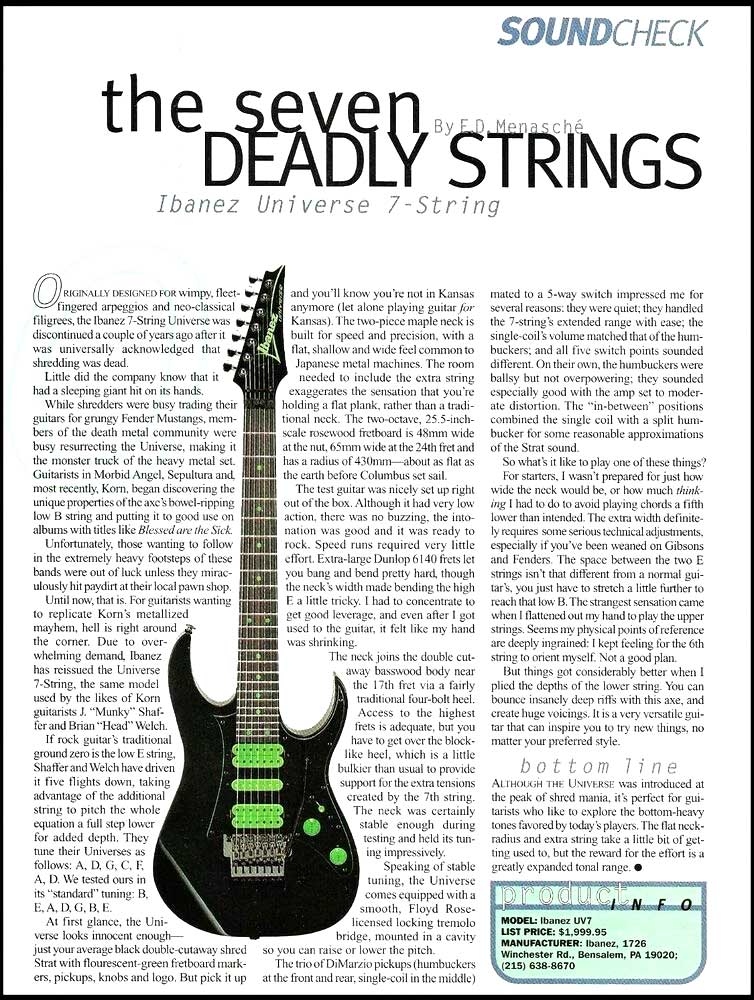
The popularization of the 7-string electric guitar is linked to Steve Vai, who highlighted the instrument in his 1990 album Passion and Warfare. Steve Vai decided to add a string to his traditional 6-string guitar to expand his bass range. To imagine this instrument, he worked hand in hand with manufacturer Ibanez. The Ibanez Universe 7 guitar (or Ibanez UV7) was marketed following this partnership. It opened up new tonal possibilities for all rock guitarists and its alternative genres. Steve Vai explains in the following video how he began working with Ibanez.
After Steve Vai, the 7-string electric guitar began to emerge. Between the ’80s and ’90s, it started appearing in many alternative rock and metal bands. Korn was one of the first to incorporate it into their compositions. Year after year, new bands in the rock and metal genres appeared, very often featuring a 7-string electric guitar. Deftones, Arch Enemy, and Dream Theater are a few examples.
In metal, it was the Swedish band Meshuggah that initiated the use of 8-string electric guitars. Like Steve Vai, the band contacted Ibanez to manufacture an 8-string guitar. The first mass-produced 8-string Ibanez guitar was the RG8, launched in 2012. This was followed by about ten other standard models, and sometimes signature models like the TAM100, associated with guitarist Tosin Abasi of the band Animals as Leaders.
Switching from a 6-string guitar to an 8-string guitar is not easy! One must already be very proficient on a 6-string electric model. You don’t automatically become a better player by using a 7- or 8-string guitar. It’s an advantage, but it won’t make you a better guitarist.
First of all, the extra strings offer a tonal advantage! They multiply the sound possibilities offered by the guitar, whether in the bass range, the treble range, or both! Each new string expands the instrument’s frequency range. Thus, the guitarist can find added value in richer riffs, deeper chords, more developed melodies, etc.
Many 7- and 8-string guitars are also longer. It takes time to get used to them. Some people have difficulty with these extended bodies.
A 6-string guitar is tuned to E A D G B E, from the lowest to the highest string. “Standard” 7- and 8-string guitars follow this tuning by adding higher or lower strings (usually lower). This results in a standard 8-string tuning of F# B E A D G B E.
See below the 7-strings standard tuning for guitars, then the 8-strings standard tuning.

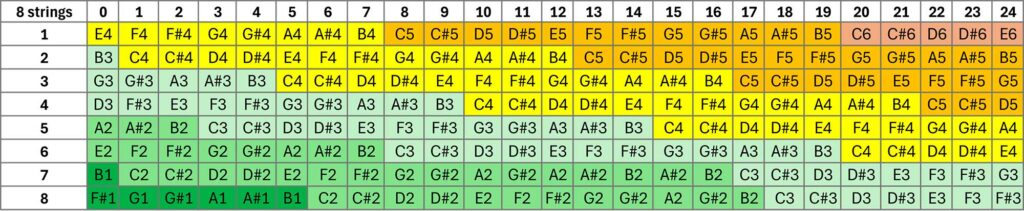
However, standard tuning is not always used by guitarists. Some adopt so-called “drop” tunings. These are tunings in which the lowest string is dropped by a tone so that the guitarist can play a powerchord (read our article about the drop D tuning). For example, an 8-string guitar in this drop tuning becomes E B E A D G B E.
It is possible to take these tunings further by lowering them by a half step, two tones, or a single tone, starting from a drop or standard tuning. For example, an 8-string guitar in drop tuning lowered by one tone becomes D A D G C F A D.
All of this is to say that tuning choice is important! Music strings compatible with these tunings are now available on the market.
The addition of these new strings on the guitar involves transformations in the dimensions of certain parts of the musical instrument. Thus, guitars with more than 6 strings have a wider nut in order to prevent the strings from being too close to each other. Without this, these guitars would be unplayable!
In general, the fingerboard of 7 and 8 string guitars is wider. As for the nut, this is essential to insert new strings! We cannot stay on the dimensions of a 6 string guitar. Their necks are often flatter or thinner. This makes it easier to play fast and riff, but the feel in the hand is very different.
As a result, widening the fingerboard involves a slight transformation of the profiling of the neck. Indeed, the guitarist must be able to quickly and easily pass over all the strings! This modification depends on the luthier or the brand. There are no rules in this field. It is therefore necessary to find the best compromise between speed of execution and the comfort of the musician.
Just look at a 7 or 8 string guitar to notice that the frets are positioned differently. They are placed at a particular angle in order to manage the tension of the strings.
Some 7 and 8 string guitars have a longer scale length than their 6 string counterparts. The scale length is often longer on these guitars, which increases the string tension for lower notes. This helps maintain clarity and intonation of the lower strings, but it can also make the fret spacing larger. This requires an adaptation time to fully take possession of the instrument! You have to take the time to practice to master the subtleties of this type of guitar.

