
Beautiful Plants For Your Interior
Beautiful Plants For Your Interior

MIDI is a digital communication protocol used in music. It enables data exchange between multiple interfaces, such as musical instruments, DAW software, and controllers. The MIDI protocol has become a standard in music production. MIDI stands for Musical Instrument Digital Interface.
In practical terms, MIDI allows communication between a MIDI controller, such as a keyboard, and DAW software. Essential musical production information, like the pitch of the note played, its duration, and the intensity with which it’s played, is captured and sent to the computer. This data is then processed through software and plugins.
The MIDI protocol does not transmit an audio signal. It is purely a data signal. It’s impossible to get sound from a MIDI keyboard unless it has a built-in sampler.
MIDI messages are data sent from a MIDI controller to software or a device capable of interpreting them. For instance, when a musician plays a MIDI keyboard, it sends MIDI messages to the DAW software (Cubase, Ableton, etc.). The software analyzes and records them to determine what the musician has played. These MIDI messages contain:
MIDI messages are divided into two types: channel messages, which are the most common, and system messages, which carry functional data.
The MIDI protocol was designed to coordinate the use of multiple MIDI musical instruments at once using a single sequencer. The sequencer is the device that records and interprets MIDI messages. It is often overlooked since most DAW software includes this feature, but standalone hardware sequencers also exist.
A sequencer can receive multiple messages from various instruments, each transmitted on a different channel. Each device is set to communicate on its own MIDI channel, allowing each to connect to a track in the sequencer.
MIDI was specifically created to standardize communications between electronic musical instruments. Initially, the protocol was used in music, but it gradually expanded into other fields, like lighting control.
The advent of electronic instruments, particularly synthesizers in the mid-1970s, raised questions about compatibility. Each manufacturer was tempted to create their own communication language. However, manufacturers began considering a common protocol that could be used and understood by all devices.
The MIDI protocol debuted in 1983 during the annual NAMM Show in the United States. It was quickly adopted by manufacturers who integrated it into their electronic musical instruments. Computer manufacturers also added MIDI ports to computers, contributing to MIDI’s popularity. The MIDI protocol has since evolved, notably with MPE (MIDI Polyphonic Expression), which allows for note-by-note modulation rather than channel-wide.
More than 40 years later, MIDI remains widely used by millions of music professionals for creation, recording, and live performances.
A MIDI controller is the device that generates MIDI data. It is a physical interface, such as a synthesizer, keyboard, pad, or any other device that produces MIDI data.
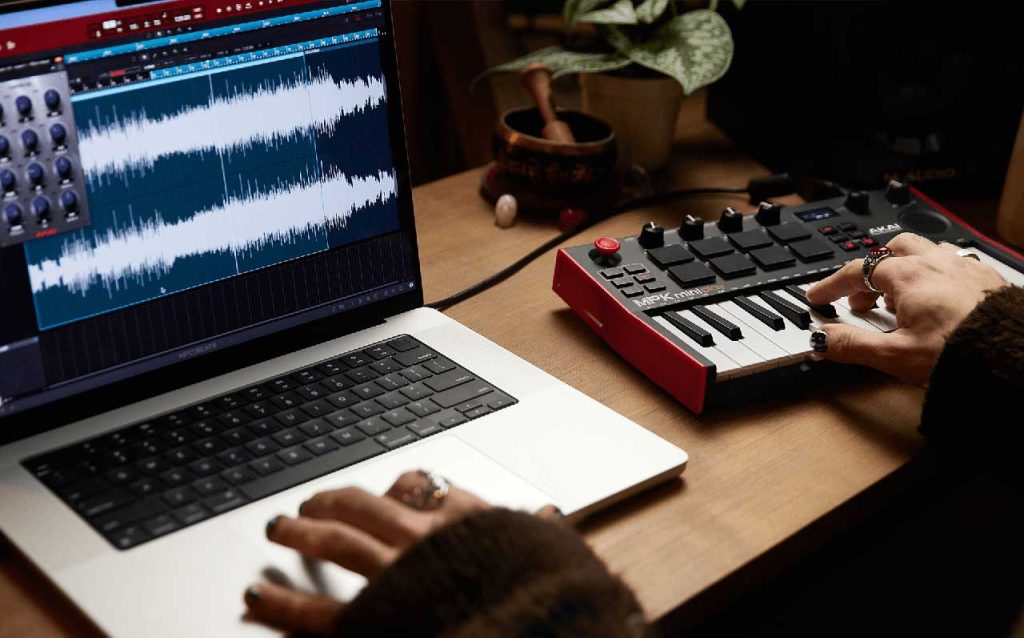
Nowadays, many manufacturers have integrated MIDI into their musical instruments. There are MIDI guitars, basses, and violins. The addition of the TRS standard has expanded MIDI’s possibilities. Introduced in 2018, it allows the use of a standard jack cable instead of the DIN connector previously used for MIDI.
A MIDI interface is a device that collects MIDI messages and transmits them to a computer via a USB cable. It’s similar to an audio interface, except it transmits data rather than audio signals. MIDI interfaces are essentially hubs with multiple MIDI ports to connect to computers that lack MIDI ports.
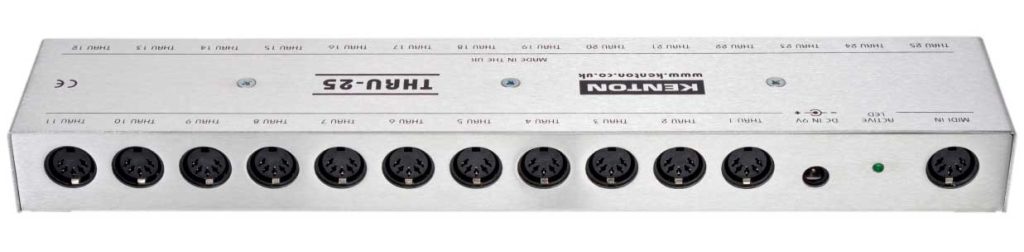
MIDI uses 5-pin DIN cables, still in use with many devices that maintain this connection type. A MIDI DIN cable has a unidirectional connection.

However, technological advancements have allowed MIDI to use other, more common cables. Today, nearly all MIDI interfaces use USB cables, simplifying connections to computers. Other devices have adopted the TRS standard to use standard TRS jack cables. There are now TRS jack-to-5-pin DIN cables available. Many other cables and technologies, including Ethernet, FireWire, and Bluetooth, can transmit MIDI messages.
MIDI uses address-based data connections. An interface must have two ports to send and receive data, as information is only transmitted in one direction. Thus, there are different MIDI ports for sending and receiving data: MIDI IN, MIDI OUT, and MIDI THRU.
As the name suggests, the MIDI IN port receives data, and the MIDI OUT port sends data.
The MIDI THRU port has a slightly more complex role, as it allows sending MIDI messages to multiple devices. A MIDI channel can consolidate data from several devices, which is where the MIDI THRU port comes in. If you connect a device’s MIDI THRU port to another device’s MIDI IN port, the second device can process data from both devices. This type of device chaining can continue in series using the MIDI THRU port, connecting devices in a daisy-chain configuration. In this setup, MIDI data transmission only works if the devices are connected through a MIDI THRU port.

MIDI offers numerous advantages for musicians. Its adoption by electronic device manufacturers, instrument makers, and musicians has greatly contributed to MIDI’s success. Its backward compatibility and flexibility make it essential for anyone exploring music creation.
Once recorded, MIDI data can be edited indefinitely and remains interpretable for decades. MIDI data can be easily altered by moving notes on a track or adjusting their duration and intensity. This is extremely useful for audio production, simplifying arrangement and reorchestration. MIDI projects from years ago can be reworked with new export options as long as the MIDI data is preserved.
MIDI’s adoption by all manufacturers has expanded the capabilities of MIDI devices. Today, there are many instruments and devices compatible with MIDI, from synthesizers to guitars, basses, and drum pads. All MIDI-compatible devices can communicate seamlessly. Even older equipment can connect with modern devices due to MIDI’s standardized protocol.
MIDI has won over musicians with its simplicity for music production. Musicians can play on a MIDI keyboard and then arrange and modify the MIDI data as needed. This saves time and money, making music creation accessible to everyone. MIDI is integrated into most music production software, allowing direct use of virtual instruments (VSTs) and other plugins.
It’s often overlooked, but MIDI also enables synchronization between multiple devices. With programming, multiple instruments can stay in rhythm throughout a song. The DAW software Ableton is widely used for this purpose!
MIDI is integral to musicians’ production workflows, present in all recording studios, especially home studios. All musicians connect a MIDI controller to their computer and DAW software like Ableton or Logic Pro. This is the most common MIDI application today.
Musicians don’t need to play every instrument in a piece. Using MIDI keyboards and VST libraries, they can turn MIDI data into sounds like flutes or violin ensembles. MIDI packs, containing chord progressions, bass lines, or rhythm patterns, can be directly imported into DAW tracks.
The MIDI protocol is also widely used in live performances to control and automate parts of the production. For stage lighting, the DMX protocol is used to control lighting systems.
The MIDI protocol most widely used today is still the original 1983 version, MIDI 1.0. Recently, a new standard, MIDI 2.0, has emerged. It is an extension of the MIDI 1.0 protocol, introducing significant changes based on four decades of technological progress. The most notable upgrade is the shift from 7-bit to 32-bit values, providing far greater data volume and precision—especially beneficial for note intensity.
Among other advances, MIDI 2.0 improves latency, supports bidirectional communication, integrates profiles, and adds new interpretable parameters. The MIDI Manufacturers Association, which manages MIDI standards, emphasizes backward compatibility between older and newer devices, supporting both 1.0 and 2.0.
MIDI 2.0 remains very recent, and it will take time before users fully understand and integrate its enhancements into their production workflows.

