
Beautiful Plants For Your Interior
Beautiful Plants For Your Interior

Music production uses a wide range of effects to generate different sounds with each musical instrument. The octaver effect is one of these tools, adding depth and sonic richness to any signal. Applying an octaver effect thickens the presence of a musical instrument. Used by guitarists, bassists, and even violinists, the octaver adds a new dimension to melodic and rhythmic lines.
Let’s explore the history, examples of use, and settings of the octaver. Whether you’re a fan of rock, funk, electronic, or blues, you’ll see why this effect has become essential in the sonic arsenal of many artists and how it can enrich your creations.
In music, an octave represents an interval between two identical musical notes. This is a consonant interval, meaning it creates a harmonious sound. Of course, the consonance of a sound depends on the listener, their culture, the music being played, and their personal perception.
Octaves are fundamental in constructing scales and tuning musical instruments. An octave corresponds to doubling its fundamental frequency. Musical notes repeat cyclically. Fundamentally, any “C” note has a higher and lower “C.” Between these two C’s, there are seven musical notes: C, D, E, F, G, A, B, plus the five flats or five sharps.
Take, for example, the note A, often referred to as “A 440,” which is the reference tuning pitch with a frequency of 440 Hz. This A has both a lower and a higher octave, so there is an octave between 440 Hz and 880 Hz, and a lower octave between 220 Hz and 440 Hz. The frequency ratio between two notes an octave apart is thus 2.
The octaver, sometimes referred to as an octave pedal, is an audio effect that transposes a signal one or two octaves below or above its fundamental frequency. It performs a transposition that shifts the notes by a defined interval into the lows and/or highs. If a musician plays an “A 440,” an octaver set to add a higher octave will add an “A 880.”
Octavers are available as standalone effect pedals. They are also found in multi-effects processors and, of course, in DAW software like Logic Pro and Ableton through integrated or dedicated VST plugins.
A monophonic octaver is designed to handle one note at a time. When multiple notes are played together, it can struggle to analyze the frequencies accurately and may produce an imprecise sound. This type of octaver follows the traditional octave effect principle. It tracks the frequency of an isolated note and generates one or more octaves below or above that base frequency.
A polyphonic octaver can detect and process multiple notes played simultaneously, such as chords. Thanks to digital advancements, these pedals use sophisticated algorithms to analyze each frequency of the played notes and generate corresponding octaves without compromising chord clarity.
A pitch shifter is a more flexible effect than an octaver. While an octaver adds one or more octaves to the produced sound, a pitch shifter can change the pitch of the note to different intervals (not just one or more octaves like an octaver does). A pitch shifter can thus generate different intervals like fifths, fourths, or thirds. The pitch shifter offers broader possibilities than the octaver.
Most octaver pedals have similar settings. Let’s dive in!
Depending on the octaver pedal, one or more knobs are provided to control the addition of one or more octaves to the signal. These knobs allow control over the volume of the octave added to the source signal. They are usually labeled as “Sub Octave” or “-1 OCT” for the lower octave and “Upper Octave” or “+1 OCT” for the upper octave.
This knob controls the balance between the source signal, i.e., the signal without the octaver effect, and the transformed signal by the octaver. It is very useful for adjusting the intensity and presence of the octaver effect.
This setting allows the activation of monophonic or polyphonic mode if the pedal supports it. The monophonic mode is ideal for simple melodic lines where only one note is played at a time. The polyphonic mode allows for playing chords and more complex melodies.
Like many effects, the octaver was born in the 1960s during the rise of amplified music. Early experiments with effects pedals focused on guitarists’ desire to transform their instrument sounds.
The first octavers were both fuzz pedals and octavers. One of the earliest models was the Maestro Bass Brassmaster produced by Norlin Music. However, it was the famous Octavia developed in 1967 that popularized the octaver effect. This pedal generated upper octave sounds combined with a fuzz effect. It was created by engineer Roger Mayer for guitarist Jimi Hendrix. The Octavia used diodes to “double” the signal frequency, creating the upper octave and producing a saturated tone. It quickly became popular with guitarists, as it produced an unexpected sound with distorted characteristics. It can be heard in the song Purple Haze.
The earliest octaver pedals were monophonic, only functioning effectively with a single note at a time, which limited their use with complex chords.
Over time, octaver pedals saw notable advances, equipped with more sophisticated technology and options. The Roland Boss OC-2 made a strong impression on bassists and guitarists alike. Released in 1982, it could generate a lower octave for each note played.
The advent of polyphonic octaver pedals brought this effect back to the forefront. Polyphonic models enable playing multiple notes simultaneously. Digital pedals have also introduced new features. Today, a wide variety of octaver pedals are available, whether monophonic, polyphonic, analog, or digital.
The octaver effect has been widely adopted across multiple musical genres. Jimi Hendrix frequently used this effect in his concerts and songs, including Fire and Purple Haze. The octaver is commonly found in rock, blues, funk, and electronic music.
In the song Seven Nation Army, White Stripes guitarist Jack White creates the bass line using his guitar and an octaver. Other effects pedals are combined to achieve the final bass-like guitar tone. Most people assume Jack White is playing a bass, but he is indeed playing a guitar. The successive combination of effects creates this impression!
Chris Wolstenholme, bassist for Muse, uses an octaver in his bass line. His octaver pedal adds a signal an octave lower to the bass line to enhance the lows and add grain and sonic density to the track. The final tone achieved is not solely due to the octaver pedal but rather a combination of multiple effects pedals. The bass line in Hysteria plays a central role in the track’s rhythm and melody, giving it a distinct groove.
In Deeper Underground, the bass line also benefits from an octaver, adding a lower octave to the bass’s original signal. This is a key element in Deeper Underground, contributing to its dark character and funky signature sound, characteristic of Jamiroquai’s style.
There are many octaver pedal models available in the effects pedal market. Here, we have selected 3 that were tested in the studio on various musical instruments.
The Walrus Audio Luminary V2 is not only a polyphonic octaver pedal but also includes a tremolo feature. It allows the combination of multiple lower and upper octaves (up to 4: –2, –1, +1, and +2). Each octave has its own volume control, and it’s even possible to add modulation effects through the “flutter” setting.
The pedal includes other standard controls: attack management, low-pass filter, mix control between the dry and wet signals, and the ability to connect an expression pedal.
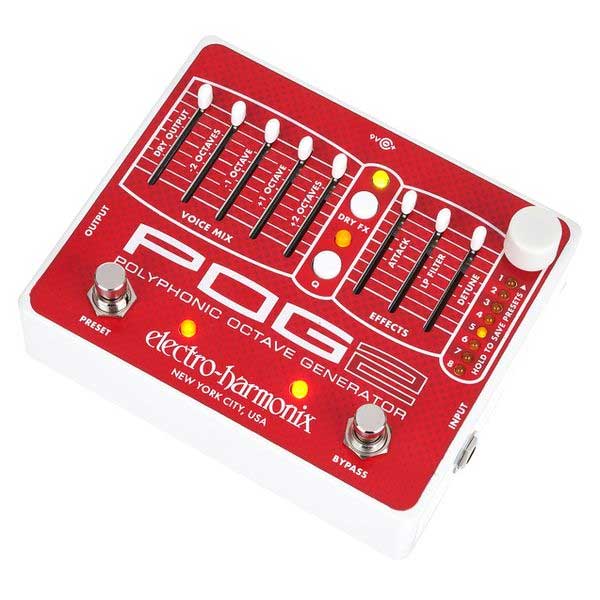
The Electro-Harmonix POG2 is a versatile digital octaver pedal that adds multiple upper and lower octaves. It offers precise control over each octave level, a “Detune” effect, and an attack function. With its preset memory feature, the POG2 is ideal for creating sounds ranging from deep basses to complex harmonies. Its sound quality and interface make it a favorite among guitarists and bassists, and it has a place on many pedalboards.
The BOSS OC-5 pedal is a versatile octaver, highly regarded by musicians for its precision and flexibility. It offers both monophonic and polyphonic modes in one unit, providing octave effects for single-note lines as well as chords. Its monophonic mode recreates the classic sound of the legendary BOSS OC-2, delivering a thick and deep lower octave. The polyphonic mode allows adding octaves to multiple notes simultaneously without losing clarity. The pedal also includes a “Direct Level” control to balance the dry signal with the octaves, along with separate adjustments for upper and lower octaves, offering a wide range of textures suited to various musical styles.
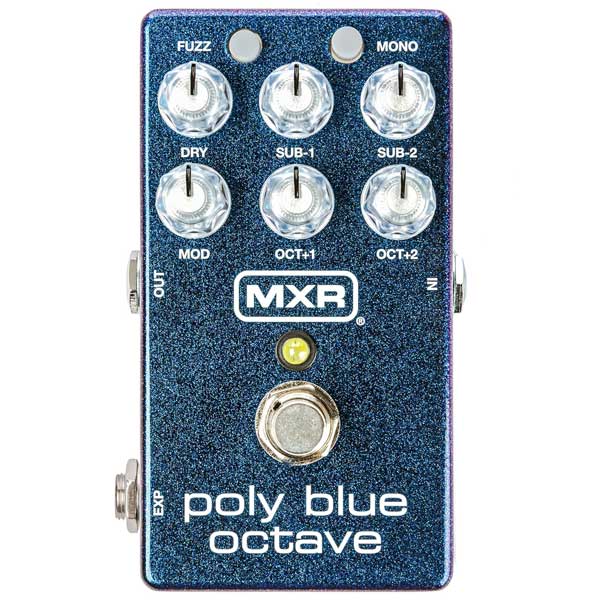
The MXR Poly Blue Octave is a digital octaver pedal offering lower and upper octaves in both polyphonic and monophonic modes. It has separate controls for each octave, along with an integrated modulation effect to enrich the sound with varied textures. The pedal also features an analog fuzz effect, enabling powerful, saturated tones.
The octaver effect is a valuable tool for musicians looking to explore new sonic dimensions. We’ve explored its functionality, history, and evolution, as well as its applications across various musical genres. By adding octaves above or below the played notes, the octaver transforms a musician’s playing, expanding their sound palette and creating immersive textures.
The octaver invites experimentation. The sounds it generates encourage musicians to try out different approaches to find the ideal tone for their intended application. It’s an effect made for the most creative among us!

