
Beautiful Plants For Your Interior
Beautiful Plants For Your Interior
If you don’t know the Neural DSP Quad Cortex, you’ve certainly missed the music news of the last few years. This multi-effect processor and amplifier/speaker/effect modeler received a lot of positive reviews upon its release. Its power made it a high-end device that has won over many guitarists, including Rabea Massaad, John Petrucci, and Dave Mustaine. It has received a large number of awards from magazines! It has become a must-have, often called a “game-changer” among modelers!
Neural DSP, the manufacturer of the Quad Cortex, is originally from Finland. The company is known for its many effective amplifier simulation plugins like Archetype: Petrucci, Archetype: Cory Wong, or Archetype: Plini. We are big fans of Parallax, which is designed for bass setups, and several Archetype models for electric guitars (see the video below presenting Archetype: Tim Henson). Many of their plugins are made with recognized guitarists, while others are based on famous amp models.
After gaining some market share in audio plugins, Neural DSP ventured into developing hardware equipment, which includes the Quad Cortex. Its unique feature lies in its desire to create physical products by integrating AI and advanced algorithmic systems to improve the sound quality of musical instruments. The offer is tempting!
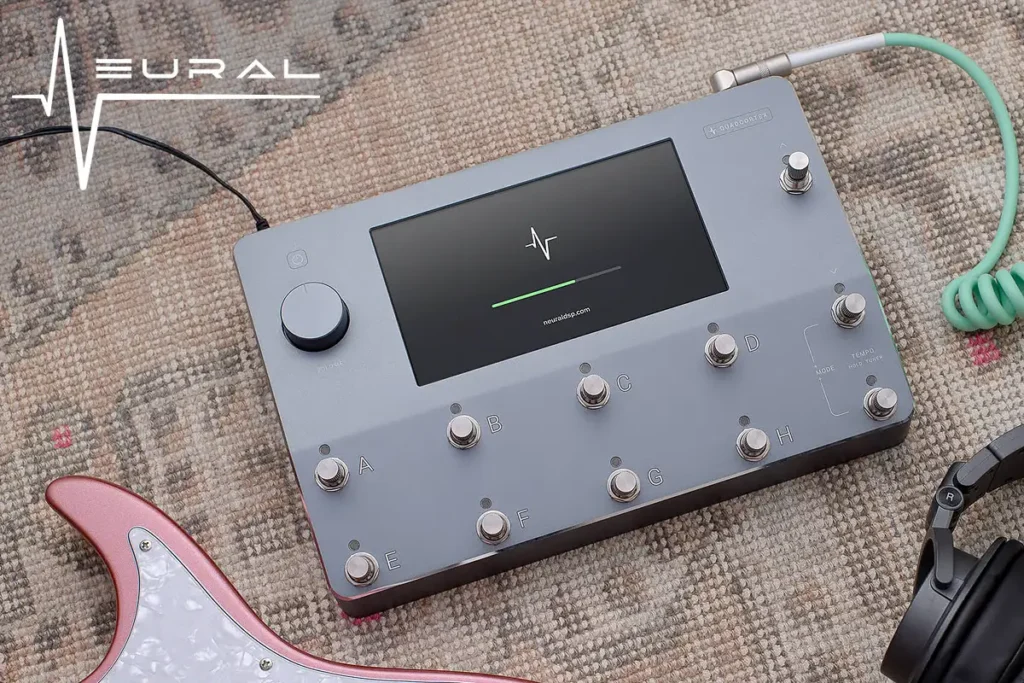
The Neural DSP Quad Cortex is an amp, speaker, and effect modeler that comes in the form of a small pedalboard. Its goal is to replace all the devices a guitarist or bassist uses with a single box. It was primarily designed to simulate amplifiers, cabinets, and effects with high precision thanks to its biomimetic artificial intelligence technology.
The Neural DSP Quad Cortex can learn and reproduce the sonic characteristics of an amplifier, an overdrive or distortion effect pedal, or a speaker thanks to its biomimetic AI technology. Other types of effects, particularly delay and reverb, are not supported to this day. The capture process uses the frequencies of a device to analyze the variations. Reverb or delay are effects that modify the temporality of the initial signal. However, the Neural DSP Quad Cortex is not capable of observing this change.
Neural states on its website:
Our biomimetic approach relies on a unique combination of advanced machine learning techniques and neuroscience; we invented a way to train an AI to perceive sound in the same way the human ear does. Quad Cortex’s neural networks hear your rig the same way you do, providing the most comprehensive and detailed detection system. The resulting digitized rigs are the most accurate and powerful on the market.
The Quad Cortex features a 2GHz quad-core SHARC+ architecture and ARM Cortex-A5, which has undeniably become the benchmark technology in amp modeling. All processors today include triple or quad cores. This architecture allows many amps to run simultaneously, combined with dozens of other effects. This is while the majority of other multi-effect processors are unable to combine successive amp modelings. Its data processing capacity offers infinite possibilities for sound design!
The main difference compared to other modelers is its gigantic and constantly evolving library. It contains a hundred amplifiers, a hundred effects, and over a thousand impulse response files! The list of devices included or downloadable from their library offers immense possibilities.
On their site, there is a table showing the correlations between the names used by Neural and the name of the device used for the capture or the one that inspired the file’s generation. Like all multi-effect processors, the majority of the proposed modules focus on electric guitars and basses. For the Quad Cortex to be a complete multi-effect processor, it also has temporal modules (reverb/delay), pitch, compressors, EQ, wah, filters, and many more. The Quad Cortex also has a very large number of slots to insert your own impulse response files. All this, not to mention the exchange and sharing library of files created by any musician!
Neural DSP didn’t cut corners! The Quad Cortex interface is very accessible! First, thanks to its large touchscreen that takes up half of the unit. Second, with 10 footswitches that are also control knobs. They can be both clicked and rotated to adjust effect parameters. This is diabolically effective for working with effects without a computer. Playing with rotary knobs on a touchscreen, or with our mouse on a computer, is not intuitive! However, there are a few adjustments to be made to perhaps simplify the long lists of modules.
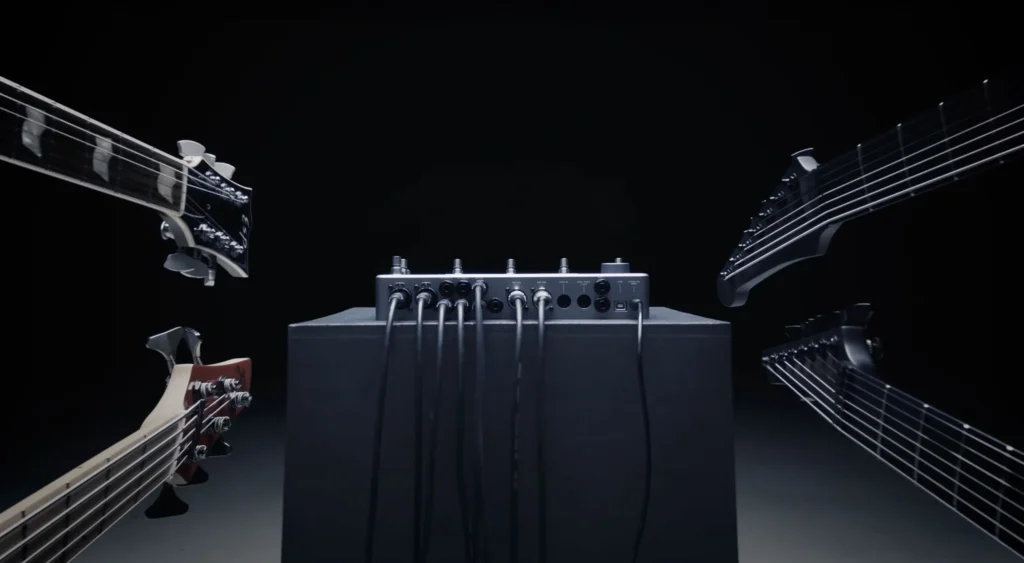
The Finnish company Neural wanted to develop a high-end multi-effect processor with all the connections expected by professionals. It’s simple, the Quad Cortex has everything: XLR/Jack inputs, two effects loops, stereo jack and XLR outputs, headphone output, MIDI In and Out/THRU jacks, a USB port to use the manufacturer’s software on a computer and to use it as an audio station, and two jacks for expression pedals.
If we had to summarize its main advantages, we should think of:
In 2024, Neural launched a smaller model called the Neural Nano Cortex. It integrates the technology of the DSP Quad Cortex into a compact box. Neural DSP has preserved the sound quality, the complete management of an audio signal, and the use of Neural Capture technology. However, it still has many differences from the high-end model. It’s difficult to say more because we haven’t tested it! The feedback seems very positive and promising.
| Nano Cortex | Quad Cortex | |
| Capture with Neural Capture | Yes | Yes |
| Uses Neural DSP plugins | No | Yes |
| IR Integration | 10 DSP IRs, Max 256 third-party IRs | 1000+ DSP IRs, Max 256 third-party IRs |
| Chains and Library | Fixed chain (noise gate, transpose, chorus, delay, reverb, neural capture, IR). 25+ amps, 300+ IRs, 5 effects. Access to the Cortex Cloud library. | Multiple chains with 90+ amps, 100+ effects, 1000+ IRs. Access to the Cortex Cloud library. |
| Dimensions | 14.4cm x 10.3cm x 6.2cm | 29cm x 19cm x 4.9cm |
| Weight | 620g | 1.95kg |
| Connections | Jack input, jack output, ground lift switch, EXP/MIDI input, headphone input, USB port. No screen (control buttons on the device). | TS, TRS, and XLR inputs, 2 x effects loops, XLR and jack outputs, Midi IN, out/THRU, 2 x jacks for expression pedals, USB port, headphone input. With screen. |
Shouldn’t this Neural Quad Cortex be in your studio? Well, it is an excellent product that brilliantly brings new features to this already very saturated market! It is not perfect on all points. Not all effects are of high quality, but this is also the case with all other multi-effect processors. It is impossible to satisfy all musicians, and there will always be effects that you love, like, and neglect. Neural DSP must still work on certain effects that are not very high quality (especially for reverbs).
The ability to use Neural DSP plugins is a huge plus. If you already use their plugins, you will immediately gravitate towards presets with a clear tone and a true sonic color.
The possibility of combining up to 4 IR modules on the same preset multiplies the sonic possibilities of the device tenfold. This wasn’t essential, but it’s a real plus. Remember the limitations of your previous multi-effects where it was impossible to chain effects the way you wanted.
Finally, the modeling works perfectly. When you create your own amp captures, you are often disappointed by the quality (always inferior to a great Celestion, for example). In this case, the Quad Cortex capture allowed for very good profiles. The Quad Cortex is worth checking out. Test it if you can; it’s very possible that it will become your new favorite device.
