
Beautiful Plants For Your Interior
Beautiful Plants For Your Interior
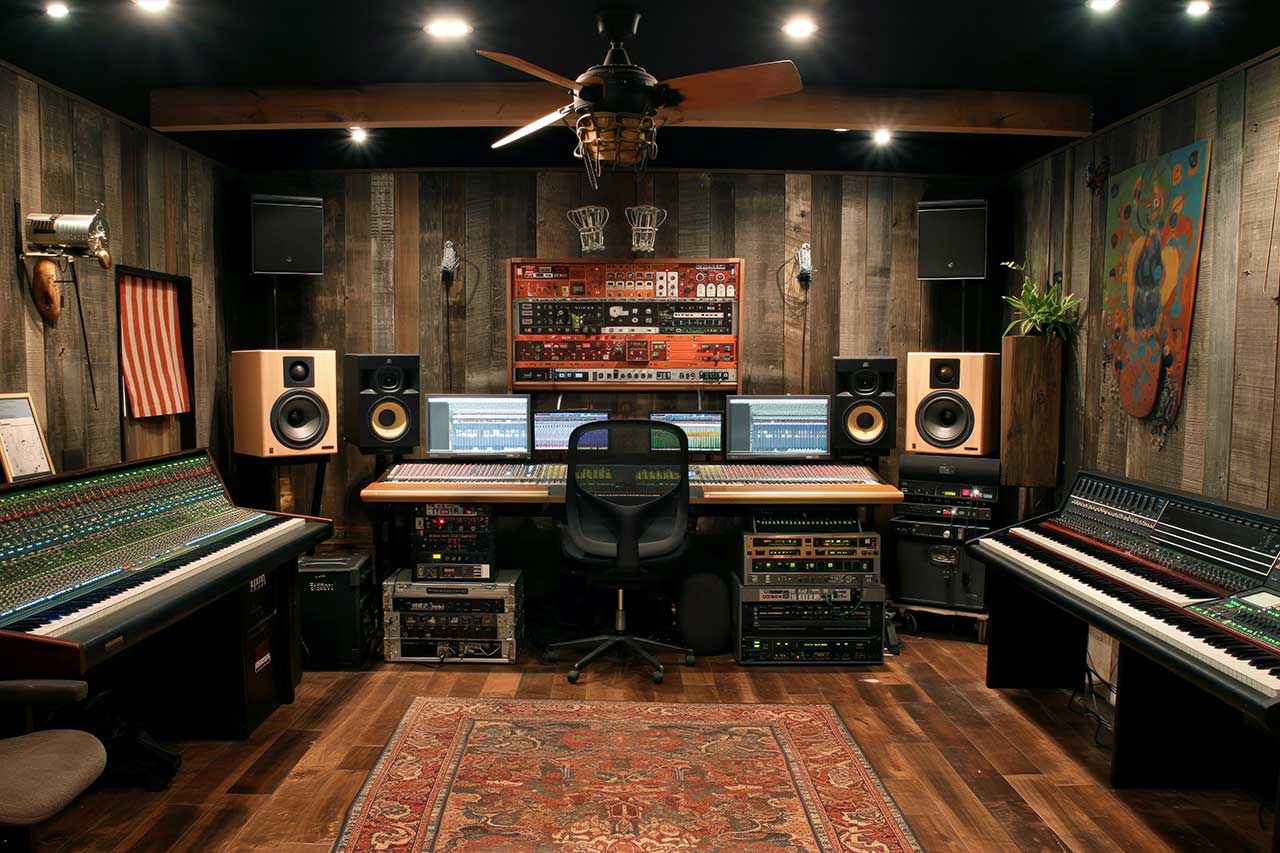
Unlike modulation or distortion effects, compressors are less frequently used because musicians are less familiar with them! A compressor doesn’t cause any significant transformation of the signal. It doesn’t distort the signal like an overdrive, for example. However, a compressor subtly enhances a signal, enriching the presence of a musical instrument. It cleverly adjusts an audio signal to be later processed by other effects!
An audio compressor is a device, a module, or a plugin connected to a sound processing software that reduces the dynamic range of an audio signal. In other words, it controls the amplitude of a signal to automatically normalize both the loudest and softest sounds.
The term “compressor” is related to the word “compression,” whose goal is to apply forces inward on a material to reduce its size. This is exactly what happens when using an audio compressor. Functions are applied that compress the signal by altering its power and amplitude. In this way, you adjust the signal’s gain.
Audio compressors are used in both music production and live performances to enhance the final signal. A good compressor boosts the softest notes and reduces the loudest ones, thereby making the audio signal more uniform.
The role of the audio compressor has been detailed in the previous paragraph, but why should one use it?
Depending on the situation, the compressor is used differently. It’s important to distinguish between live conditions and studio recording conditions, as they don’t have the same objectives! However, compression is useful in both cases! When used properly, compression can highlight certain elements to achieve a targeted mix.
It should be noted that humans tend to prefer compressed sounds. In fact, the sounds delivered by our everyday devices (TVs, phones, streaming services, computers, etc.) are all compressed to some degree. The habit of hearing compressed audio signals gives our brains the impression that they sound good! Here, we are referring to “acceptable compression rates.” An ultra-compressed signal won’t sound good because it has lost too many elements!
Compressors have undergone significant technological advancements. There are several ways to compress a signal, and each technique performs compression with its own characteristics. The final signal obtained is never the same!
There are four types of analog compression technologies:
The most common are VCA, FET, and optical compressors. VCA compressors use integrated circuits that provide fast and efficient performance. This technology is found in most compression pedals.
FET technology is based on transistors with shorter response times. These were invented to replace the expensive and fragile tube compressors. They deliver a slightly more aggressive sound and are applied to basses and electric guitars, for example. They are widely used in studios. The Universal Audio 1176 is a landmark model!
Optical compression is slow and gentle. It is widely used for processing the sound of acoustic instruments. A light spectrum affects the audio signal’s dynamics. As the signal amplitude increases, the light cell emits more light, which reduces the amplitude.
Tube compression is one of the oldest forms. Tubes give a very characteristic vintage sound. Their response time is slower than the other types of compression mentioned. The resulting tonal coloration is unique! It’s a bit like the holy grail, similar to old tube amplifiers!
There are many settings to configure an audio compressor. Generally, there are six parameters:
Setting the threshold
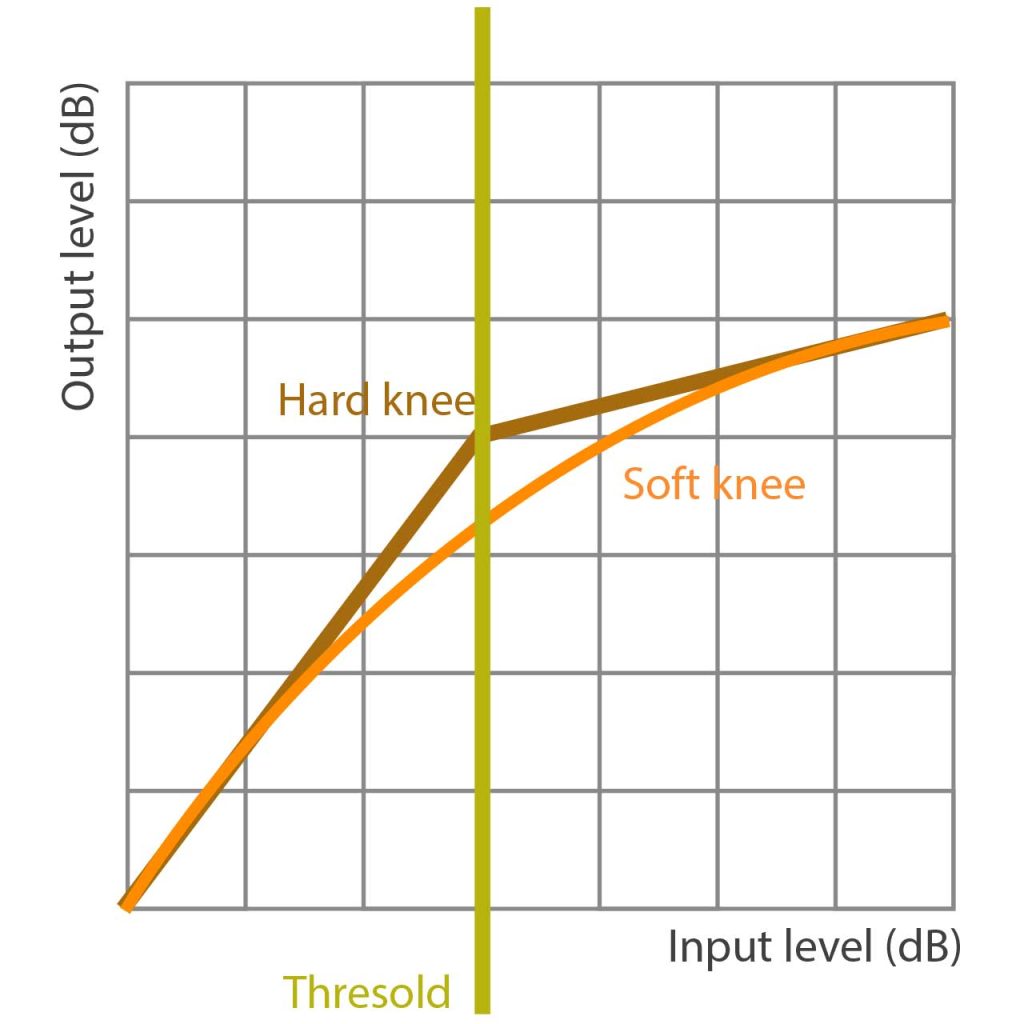
The threshold defines the level at which the compressor is activated. It is expressed in decibels. The threshold determines when the compression kicks in. Below this threshold, the compression is inactive.
Setting the threshold depends on the signal! There’s no key value to define for a good result. It’s important to analyze the signal to find the appropriate threshold.
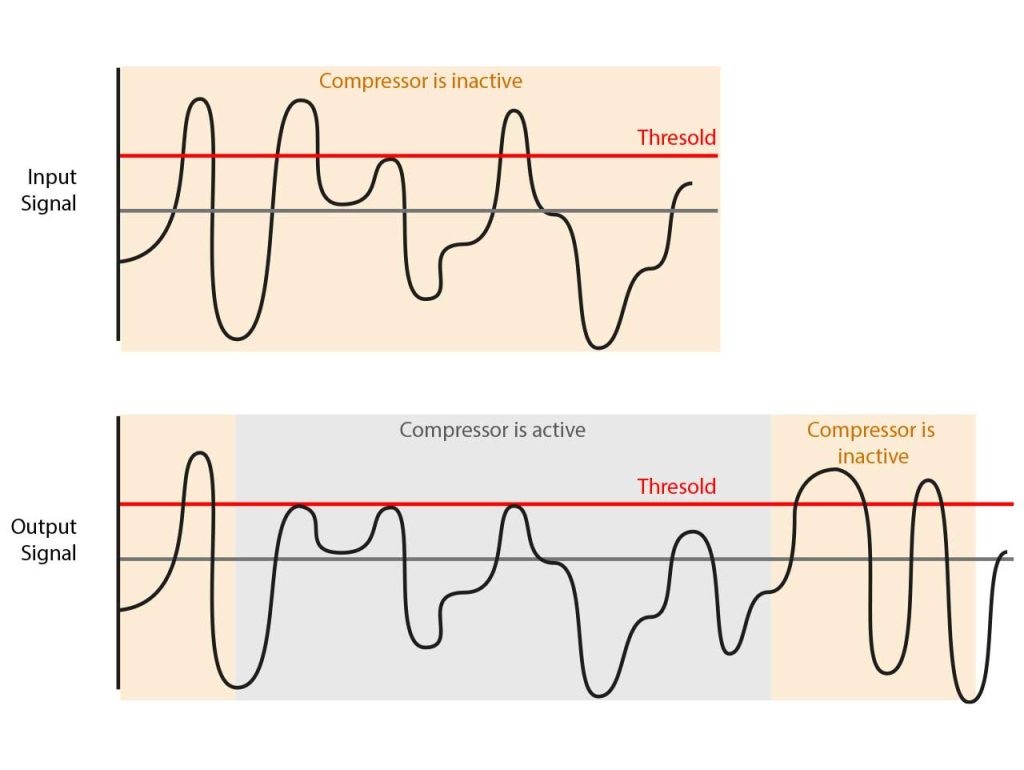
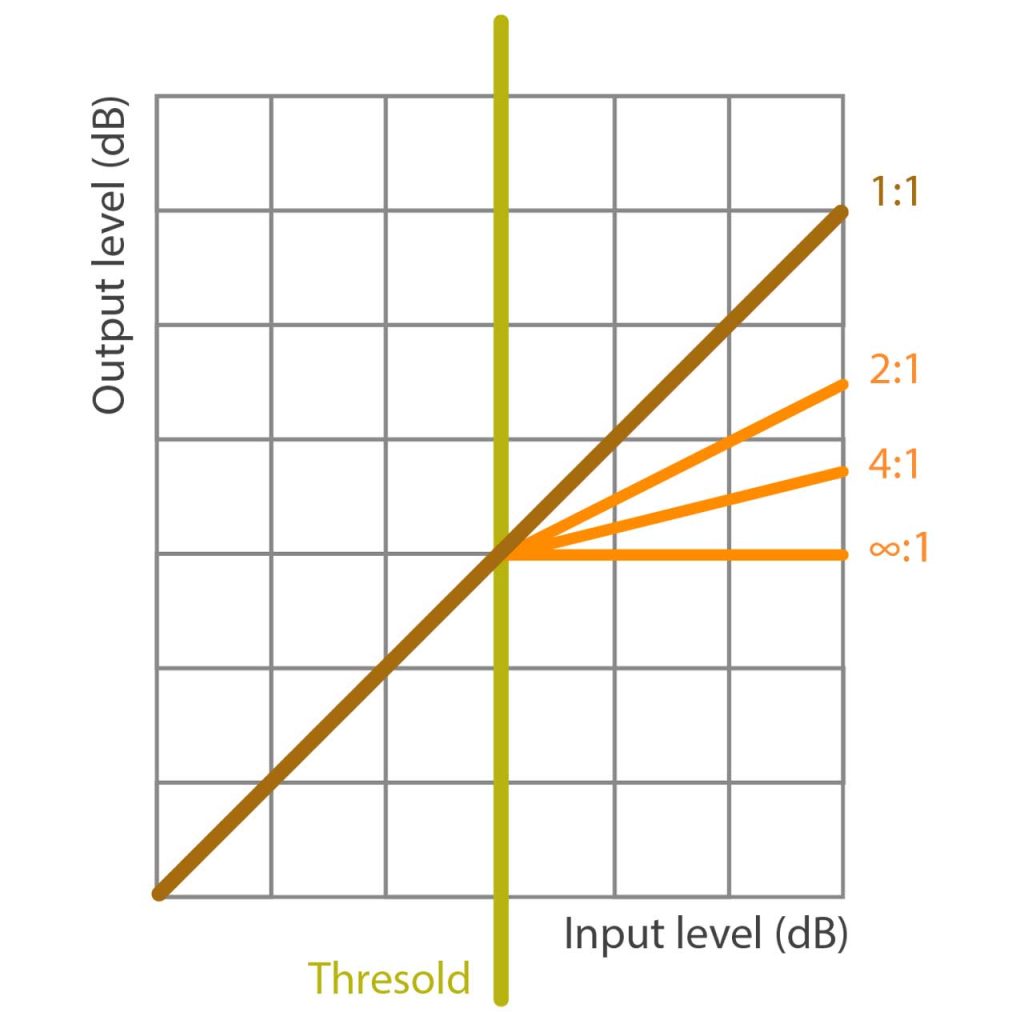
The ratio determines the amount of audio compression once the threshold is activated. It sets how much compression is applied to the signal.
The principle is very simple: the higher the ratio value, the more compression there is. Conversely, the lower the ratio, the less compression is applied.
The ratio is expressed as values like 4:1 or 2:1. For example, a 4:1 ratio means that if the input level is 4dB above the threshold, only 1dB above the threshold is output.
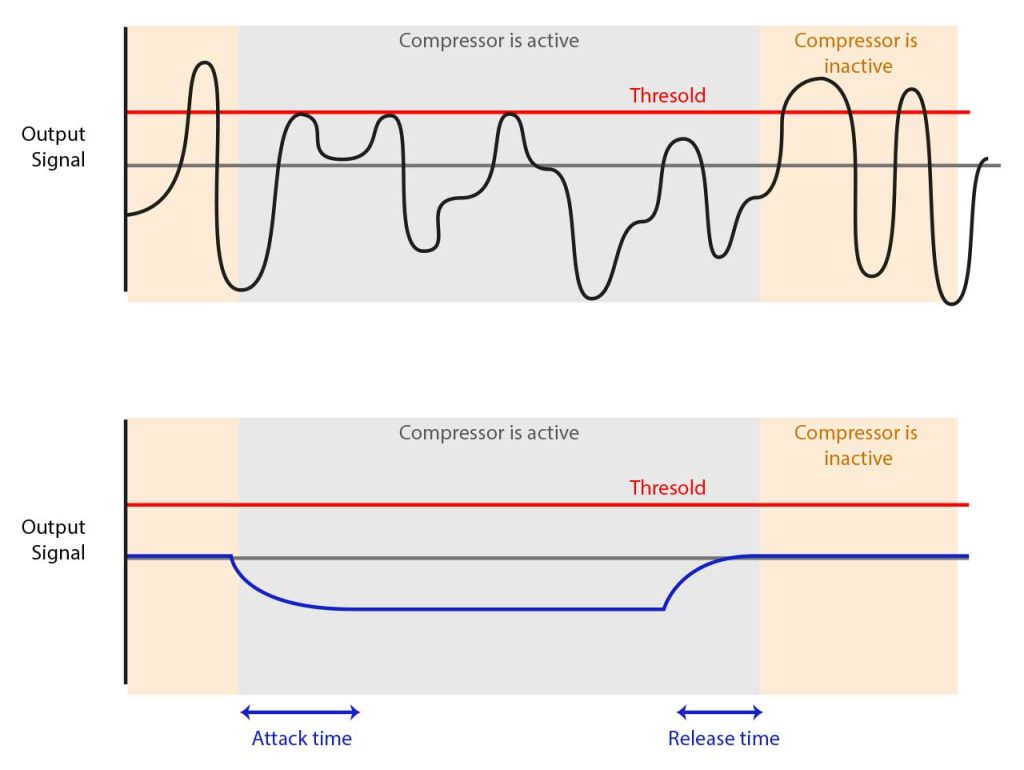
The attack defines the compressor’s reaction time to process the signal. In how many milliseconds should it be fully active?
When the threshold is exceeded and compression is triggered, the attack determines how long it takes for the compression to be fully effective. If you set it to 15ms, there will be a 15ms transition between the original and compressed signal.
The release defines the time it takes for the signal to return to normal once the compressor is deactivated. When the threshold is reached, the attack comes into play. Once the threshold is no longer reached, the release takes over from the attack. It is expressed in milliseconds. To set it correctly, you need to listen to the signal to find the right parameter. The release should affect the moments when the threshold is both activated and deactivated. This parameter influences note length, also known as sustain.
The knee defines the type of transition between the activations and deactivations of the threshold. It can be compared somewhat to a fade effect.
The stronger the knee, the more sudden and noticeable the compression is. When set to the highest level, the transition is immediate.
On the other hand, the lighter the knee, the more gradual and smooth the compression becomes.
The gain normalizes the final output level of the signal to balance the volume of both the softest and loudest parts. It ensures a uniform signal.
This is a common setting found in many other types of effects and devices.
The compressor is a tool for enhancing the final audio signal! However, like all effects used in audio production, there are no ideal settings! Compressor settings depend on the signal and the playing conditions. They are never the same from one session to another.
In music production, a compressor can be used in multiple ways! Depending on the needs or the musical genre, it can be calibrated to be either subtle or aggressive.
For live use, the sound engineer uses compressors to calibrate incoming signals. A compressor is applied to the singer’s voice because the human voice competes with the frequencies of other musical instruments. As a result, the vocals are boosted to be more present in the overall mix.
Compression is also used for other instruments, notably basses, drums, and other percussion. In these cases, the goal is to accentuate the rhythm and groove provided by these musicians. The compressor can be added by the musician directly onto their pedalboard or managed by the sound engineer. Bassists are big fans of compressors, especially in the fingerstyle bass world. Compression evens out the inconsistencies during picking.
Guitarists use compressors to increase their sustain. Sustain refers to the length of a played note. The compressor alters the dynamics and adds sustain to weaker notes. It’s a commonly used pedal effect by funk, folk, and country guitarists and bassists.
In conclusion, keep in mind that there are many ways to configure a compressor. The type of instrument played, the musical genre, the rhythm of the tracks, the tone sought, and the playing style all influence the parameters to select. Experimenting is not optional! Take the time to test different settings!
When you’re playing live, the signal produced by your guitar is your responsibility! It’s up to you to shape it! You can’t expect the sound engineer to transform the raw signal from your instrument. That’s not their job! They’re already busy with the general mix of all the instruments and vocal microphones. You need to get your hands dirty and work on the signal you’re going to send to the mixing console. This involves using various effects, such as compression.
There are many compression pedals used by guitarists, bassists, and other musicians. Their purpose is to even out the sound, thicken it, and give it more presence. Certain frequencies can be enhanced, which might be underrepresented by the instrument.
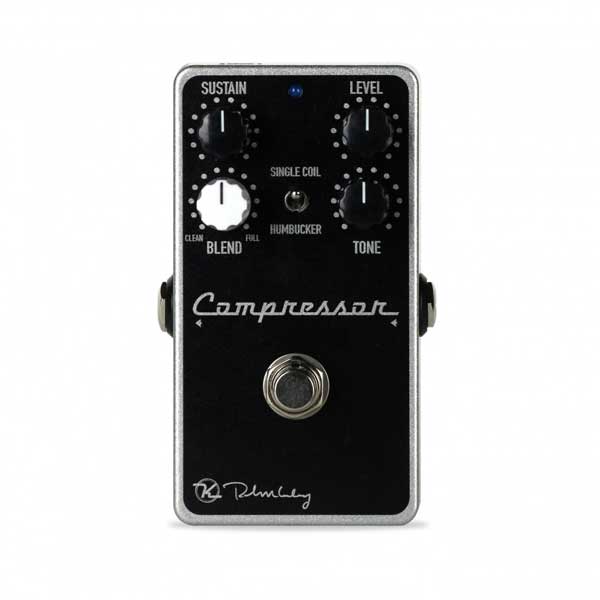
The Keeley Compressor Plus is one of the most comprehensive options on the market today! It’s suitable for both guitarists and bassists! It delivers a beautiful increase in sustain while maintaining playability and preserving strong attack! You can use it with or without a pick while keeping the same volume! With settings for sustain, level, tone, and blend, it has everything you need to manage compression. It’s clearly a must-have on your pedalboard! If we had to choose just one pedal, it would definitely be the Keeley Compressor Plus!
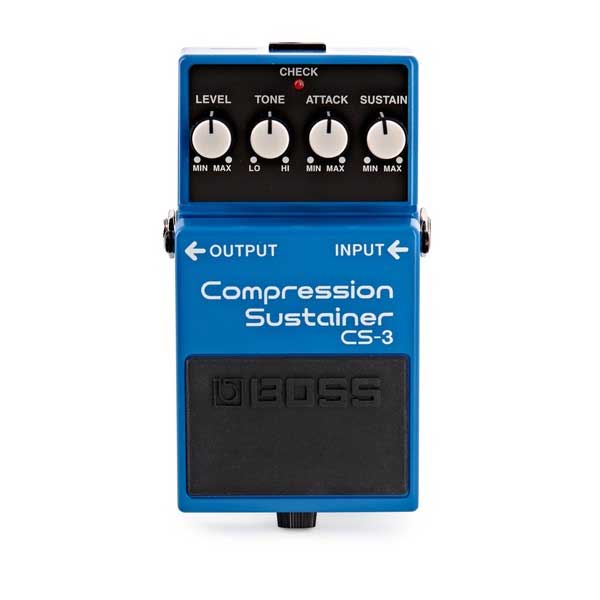
The Boss CS-3 compressor offers excellent value for money (like many pedals made by Boss). It plays its role perfectly and is suitable for smaller budgets. However, some drawbacks include level differences with an occasional “pumping” effect that occurs unexpectedly. It also tends to color the sound by adding too much treble. If you’re very particular about sound quality, it’s better to go straight for the Keeley Compressor, which remains far superior.
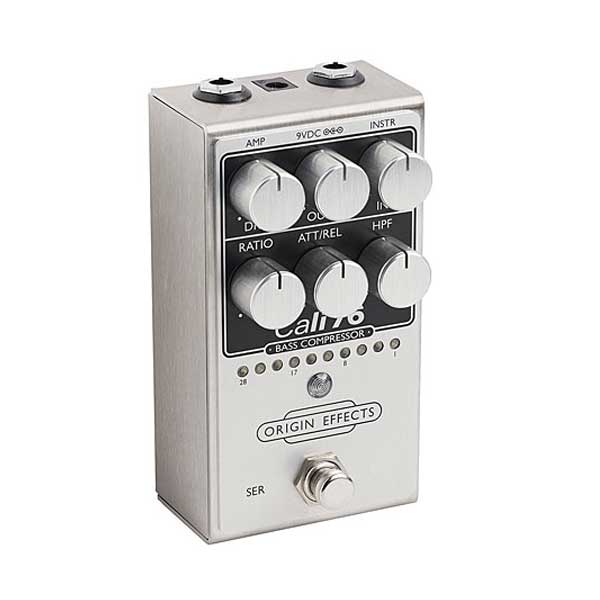
There is a guitar version and a bass version of this compressor called the Origin Effects Cali76 V2 FET and the Origin Effects Cali76 V2 Bass. The unique feature of this compressor is that it uses FET technology. This brings studio-quality compression compared to traditional VCA compressors. Its higher price is due to the use of FET technology. This compressor delivers truly exceptional compression quality! It’s inspired by the classic Urei 1176 studio compressor. If you wanted to, you could use this pedal in a studio environment! You can’t say that about many compression pedals! That’s a key strength of this pedal! On the downside, the compression lacks some warmth and its use may seem complicated to beginners.
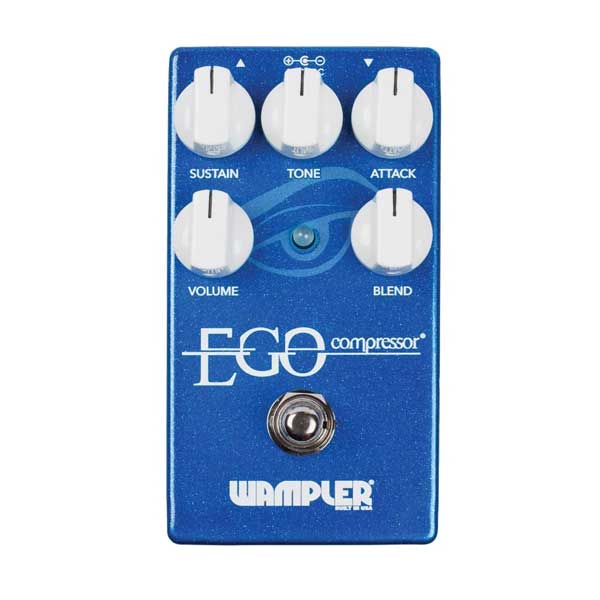
The Wampler Ego compressor has become a true classic! The compression offered provides great sustain and excellent volume control. It also enhances attacks without losing clarity. Equipped with five knobs to adjust sustain, tone, attack, volume, and blend, it is designed to meet all needs. The blend parameter is a real plus for creating your own mix between the compressed signal and the original signal.
A compressor is placed as early as possible in an effects chain. It is an extension of the natural tone of the voice or musical instrument. It transforms and improves the input signal so that the subsequent effects benefit from its advantages. When placed at the end of the effects chain, it will compress the entire set of effects, resulting in a somewhat muddled sound.
Sources: Wampler, Cali, Boss Keeley

