
Beautiful Plants For Your Interior
Beautiful Plants For Your Interior

Knowing who first used a distorted sound remains complex because amplifiers generated distortion at high volume. All musicians experienced distortion issues during that time.
When playing a musical instrument, you create a sound spectrum consisting of a fundamental frequency representing the note played and multiples of this frequency, also known as harmonics. Saturation occurs when these harmonics are transformed. To understand what saturation entails, let’s observe what a normal signal without saturation looks like.
In the history of rock music, distortion contributes to the legend of this sonic universe. All rock guitarists have saturated the sound of their guitars, leaving an unmistakable sonic imprint on generations. However, did you know that distortion was born from an accident?
In the early days of electric music, amplifiers tended to produce saturation as soon as their volume level was pushed. At that time, saturation was an undesirable effect hated by sound engineers. But upon discovering the sonic possibilities, some guitarists abused it to create new sounds.
Legend has it that the first distorted sounds were offered by Ike Turner’s guitarist, Willie Kizert, on the track “Rocket 88” in 1951. He was then followed by Paul Burlison with Johnny Burnette on “Train Kept A Rollin'” in 1956. In these two early tracks, the generated distortion is quite light but very present. The Kinks and Dave Davies with his riff on “You Really Got Me” are also often mentioned. In this song, the saturation is quite audible.
Knowing who first used a distorted sound remains complex because amplifiers generated distortion at high volume. All musicians experienced distortion issues during that time.
When playing a musical instrument, you create a sound spectrum consisting of a fundamental frequency representing the note played and multiples of this frequency, also known as harmonics. Saturation occurs when these harmonics are transformed. To understand what saturation entails, let’s observe what a normal signal without saturation looks like.
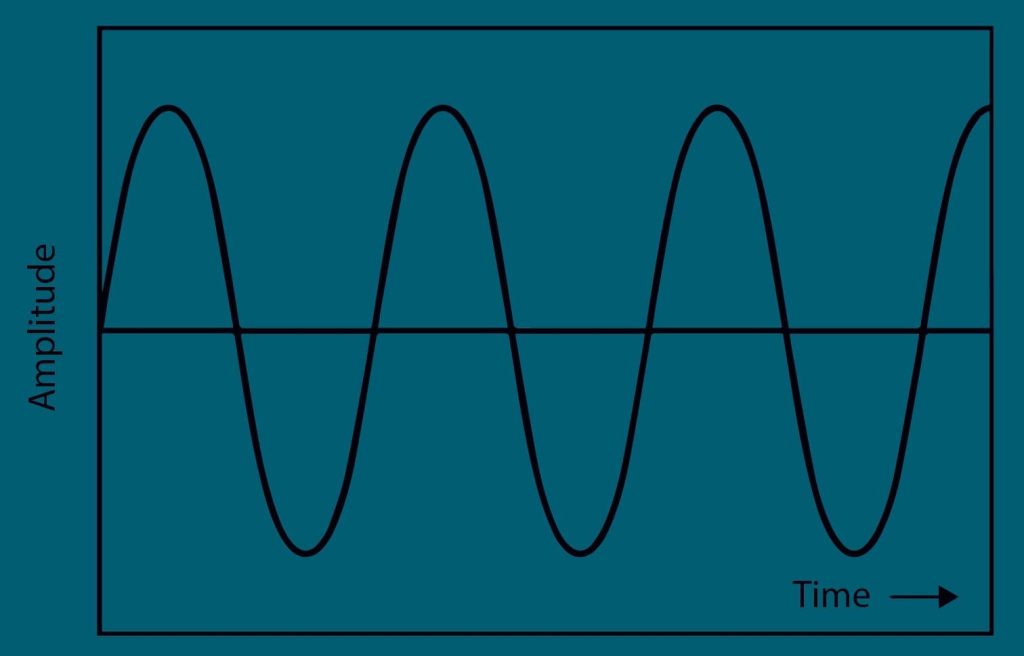
There are 3 types of saturation effects: overdrive, distortion, and fuzz. They all alter the harmonics of the signal but in different ways and to varying degrees of significance. Fuzz is the most aggressive as it truncates the curve to form a square wave.
Each saturation effect will modify this signal to different extents. They distort the symmetrical and regular wave by clipping it more or less harshly at the top and bottom of the curve. This is referred to as “soft clipping” and “hard clipping.” See the diagrams below to understand the difference between the two types of clipping.
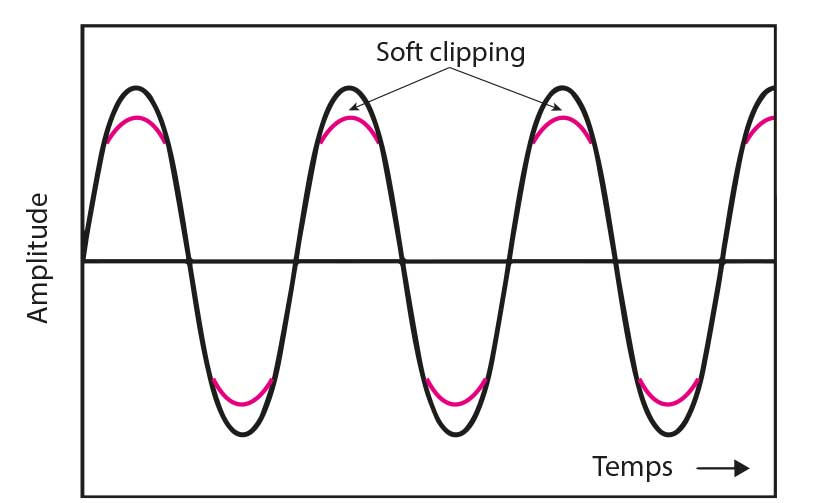
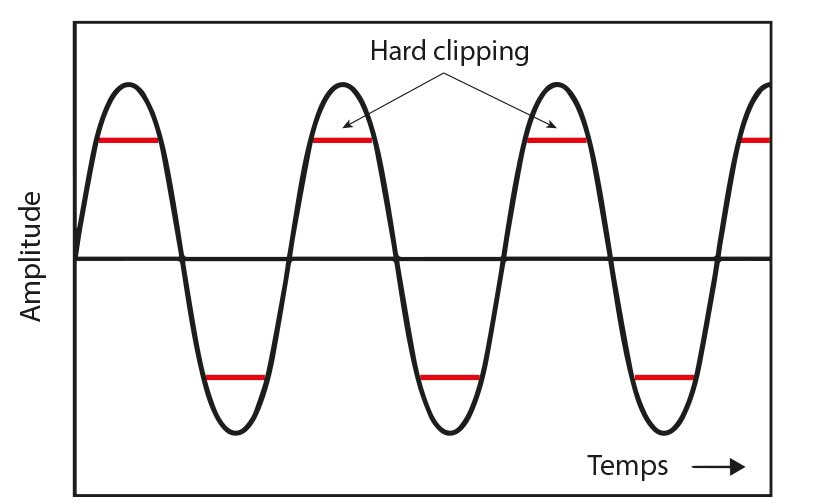
By transforming the waveform of the signal, a distorted sound is generated. Below are the differences between a sound without saturation effect and the 3 saturation effects.
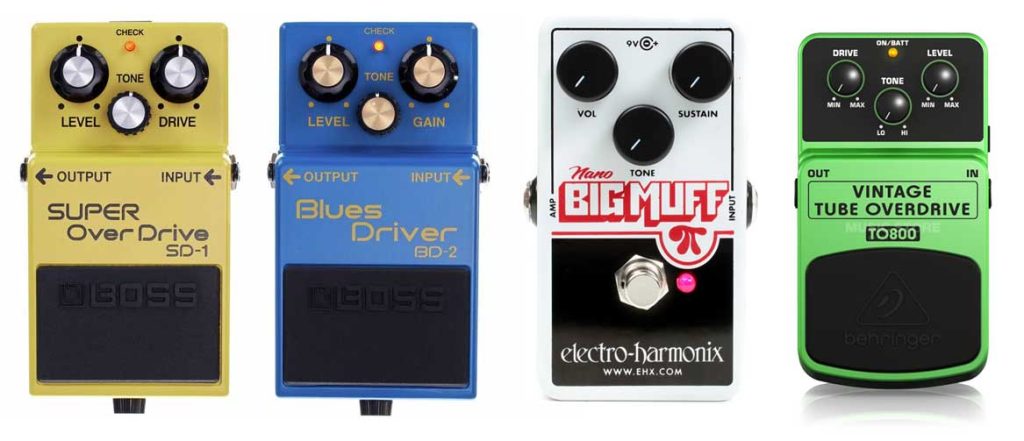
Overdrive is the lightest and least aggressive saturation effect. It is achieved by pushing the volume of an amplifier, which clips a portion of the signal, generating saturation.
Some overdrive pedals commonly used by guitarists.
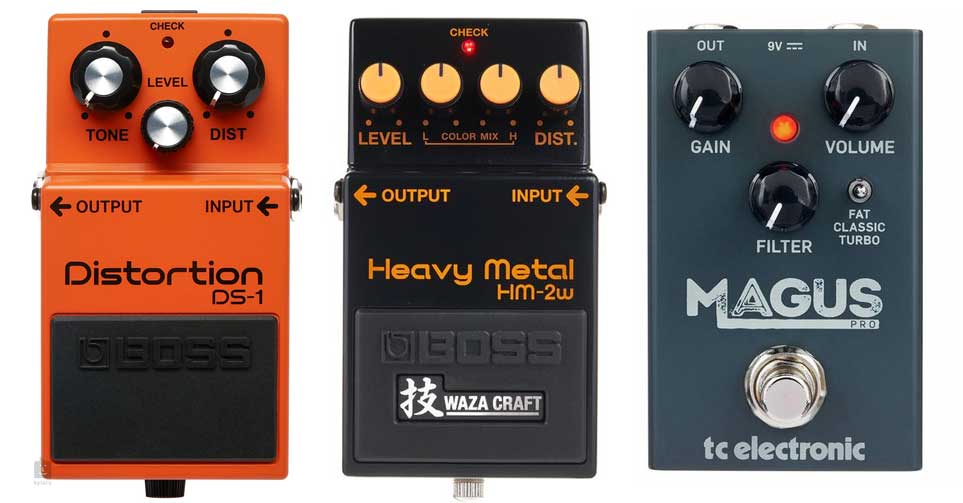
Distortion sits between overdrive and fuzz. Distortion pedals produce a more aggressive saturation effect than overdrive. Like overdrive, distortion alters the sound wave by pushing the gain using operational amplifiers.
Some distortion pedals commonly used by guitarists.
The fuzz effect is by far the most aggressive of the saturation effects. It is the original saturation effect that was found when amplifiers were pushed to their limits. In this case, the signal is completely clipped, and a portion of it disappears.
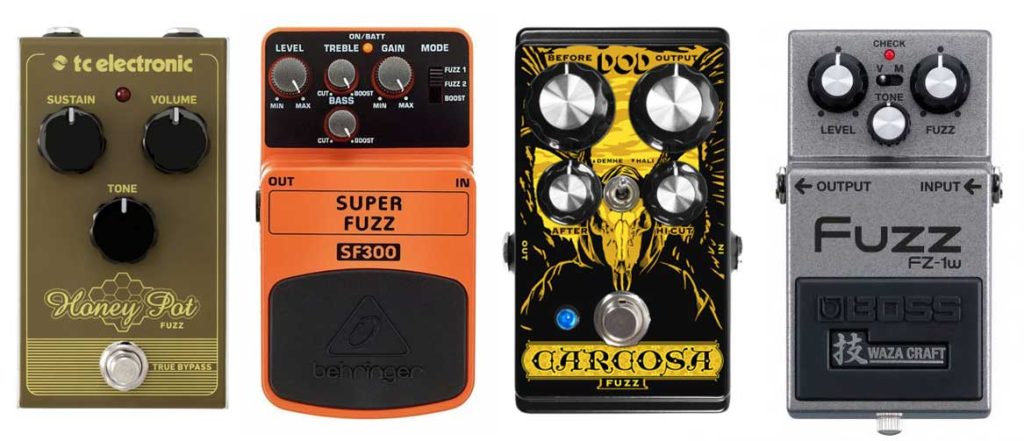
Unlike distortion and overdrive pedals, the operation of fuzz pedals is different. They do not use gain operational amplifiers but transistors that introduce harmonics into the signal as soon as it is pushed.
Some fuzz pedals commonly used by guitarists.
Saturation has evolved from a technical flaw into a defining feature of modern music, particularly in rock and its subgenres. Born from accidental overdrives and misunderstood amplifier behaviors, it was embraced by pioneering musicians, and now used by every musician. Overdrive, distortion, and fuzz each offer distinct tonal colors, allowing guitarists to shape their sound.

