
Beautiful Plants For Your Interior
Beautiful Plants For Your Interior
You are the proud owner of several individual effects pedals! You have the bad habit of daisy-chaining them! It’s high time to switch to a proper power supply for your pedalboard. If effects pedals are an essential tool for your playing, you must not neglect their power supply. Proper power management is a guarantee of quality for your output signal. Let’s find out what parameters to check before buying a power supply for your pedalboard? What solutions exist depending on the number of pedals installed?
When a guitarist has about ten individual effects pedals, they place them on a pedalboard. This pedalboard requires a general power supply to provide electricity to the entire system.
Voltage is measured in Volts (V). It is one of the first characteristics to identify on a pedal. It can be found either directly written on the effects pedal, in the manual provided by the manufacturer, or as a last resort, by searching on the manufacturer’s or retailer’s website!
Most of the time, it is written above the power connector. It is essential to respect the indicated value! If you provide a higher voltage, the circuits won’t appreciate it, and you will fry the pedal! If you provide less power, the pedal won’t work!
Most of the effects pedals on the market use 9V. Sometimes, certain models use a range of voltages. This is often the case with effects processors. In such cases, it is specified “9-18V,” or from 9 to 18 Volts.
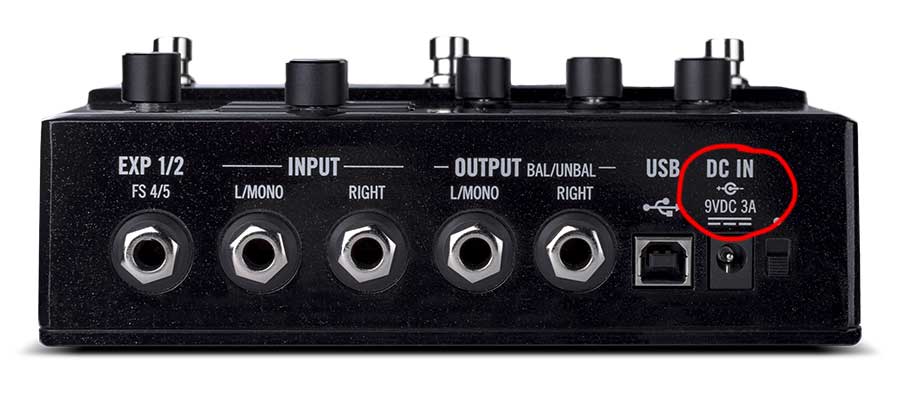
Nowadays, the majority of individual pedals require 9V. When looking at older models, you may find needs for 12V, or even 18V. Some power supplies come with a voltage switch. Here is an example of the mention noted on the Line 6 HX Stomp effects processor.
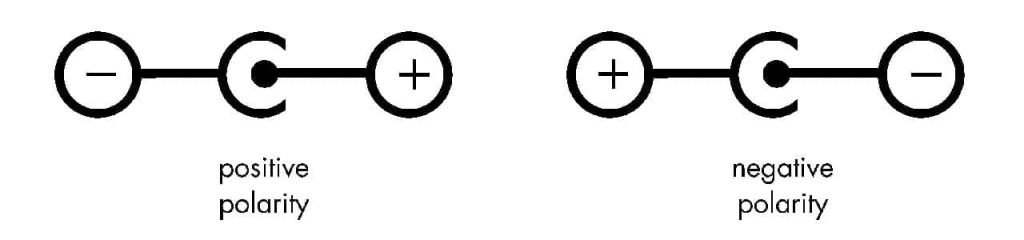
Almost all modern pedals use a center-negative polarity. But there is also positive polarity, represented by the following symbol.
The two symbols are very similar, yet using the wrong polarity can permanently damage a power supply! Be sure to check the polarity before choosing a power supply!
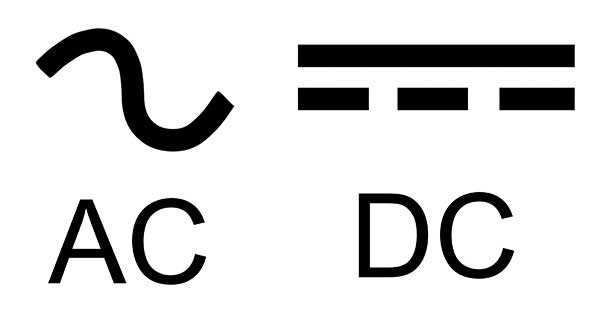
When a pedal operates in DC, it is marked as DC. If it operates in AC, the notation AC is used. Few pedal models use alternating current. Most of the market consists of pedals that run on direct current. When a pedal requires alternating current, manufacturers typically provide the power adapter. This is the case for most effects processors.
Generally, this parameter is indicated next to the voltage notation. For example, if it says 9VDC, it means that the pedal uses a voltage of 9 Volts in direct current.
Current is measured in Amperes (A). In the field of effects processors, we speak in Amperes. But, in the field of small individual pedals, we communicate in milliamperes or mA. Milliamperes are used for better clarity. It’s easier to understand 10mA than 0.01A. An Ampere is a thousand times larger than 1000 milliamperes.
A common mistake is to believe that a higher amperage might fry a pedal. This is false! The power supply only provides the current necessary for the proper operation of the device. Don’t confuse current with voltage!
The current mentioned on a power supply corresponds to the maximum value it can deliver. If a power supply is rated at 50mA, it is suitable for a pedal requiring 30mA. In the case of a pedalboard, you calculate the total requirements of the pedals and select a power supply greater than this total. Each pedal on your pedalboard requires a certain amount of current to operate properly. Allow for a bit of extra capacity in case you want to add a few new pedals!
There are isolated and non-isolated power supplies. Isolated power supplies prevent noise and electrical interference. We all started with effects pedals connected in parallel on a 9V power supply, all connected with a power strip. It works, but in terms of quality, it clearly needs improvement! The more pedals there are, the more noise is present, as there is no isolation.
Analog pedals are less prone to generating noise. However, digital pedals create small disturbances in the power supply. These disturbances are transmitted from pedal to pedal when connected in parallel. Other noise amplification effects can occur, like ground loops. It is to address these challenges that manufacturers have developed ways to isolate effects pedals.
There are several types of isolation. The most common is galvanic isolation, which uses a transformer-based system. It provides a separate power path for each pedal and eliminates ground loops. By comparison, in a daisy chain setup, the power flows from one pedal to the next, amplifying noise pedal after pedal.
First, to determine the power needs of a pedalboard, you need to identify the pedals and list their requirements. Take a small notebook and carefully note the required voltage for each pedal!
Now that you have the needs of each pedal, you can calculate the final requirements to power your entire pedalboard.
In this case, it is possible to use 9V batteries. At least for starting out, as using batteries is neither ecological nor budget-friendly. 9V batteries come at a cost. In the long run, it’s not very profitable. Especially since you always need to have spare batteries on hand. A 9V battery can run out within a few hours, especially if you forget to unplug the right jacks after soundcheck. It’s not the best solution, but it can be a temporary fix for beginners.
If you only use 3 to 4 analog pedals, a daisy chain setup is sufficient. There may be some slight noise, but nothing too bothersome! In this case, look for a simple power supply that can handle powering the pedals. This is known as a standard power supply.
If you use both analog and digital pedals, which are more power-hungry and more prone to noise, you will need to choose a higher-quality power supply. Indeed, digital pedals tend to generate buzz that propagates through the power supply to other pedals. It’s important to choose an isolated and regulated power supply. This means that each outlet receives power independently, which prevents signal interference. Moreover, the build quality of these power supplies generates a stable current. The music instrument market offers a plethora of power supplies from dozens of different manufacturers. You need to select the model that suits your voltage, number of outlets, and amperage needs.
This type of power supply is installed on the back of the pedalboard. It will add weight to the pedalboard, but in return, it offers unmatched sound quality, saves space on the pedalboard, and simplifies cabling.
Below is a selection of 4 isolated power supplies for your pedalboard. You can read after the table a description per power supply: the Cioks DC7, the Strymon Ojai, The Walrus Audio Canvas 8 and the The Voodoo Lab Power 2 Plus.
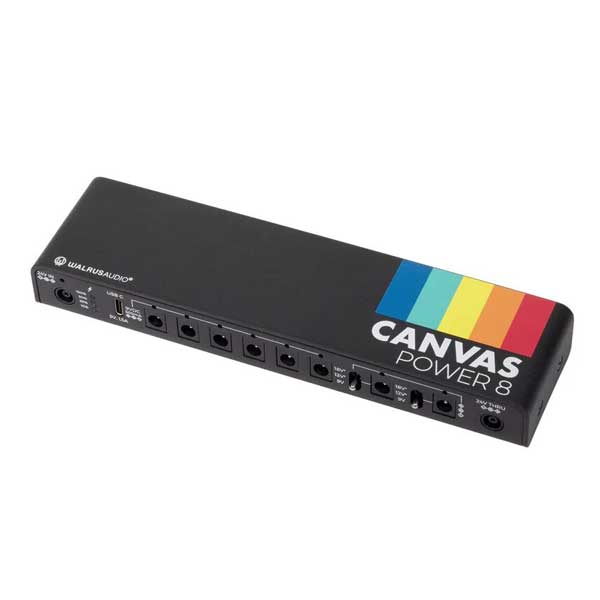
The manufacturer Walrus is known for its numerous effects pedals. It also offers pedalboard power supplies under the Walrus Audio Canvas name. There are several versions that evolve in terms of voltage, number of outlets, and thus the maximum number of pedals to connect. Regardless of the model, these power supplies are quiet and ensure excellent signal isolation. They are also extremely compact with a very nice design. The cases are very thin, fitting easily under any pedalboard. Another advantage is that Walrus Audio Canvas power supplies are modular. You can very well start with the Canvas Power 5 and pair it with another Canvas Power supply if your pedalboard evolves. You will only use one power block for both power supplies!
The Canvas 8 offers 8 isolated power outputs of up to 500mA – 9V. Among the 8 outlets, two can switch to 12V or 18V. We use this model and it is clearly a great product!
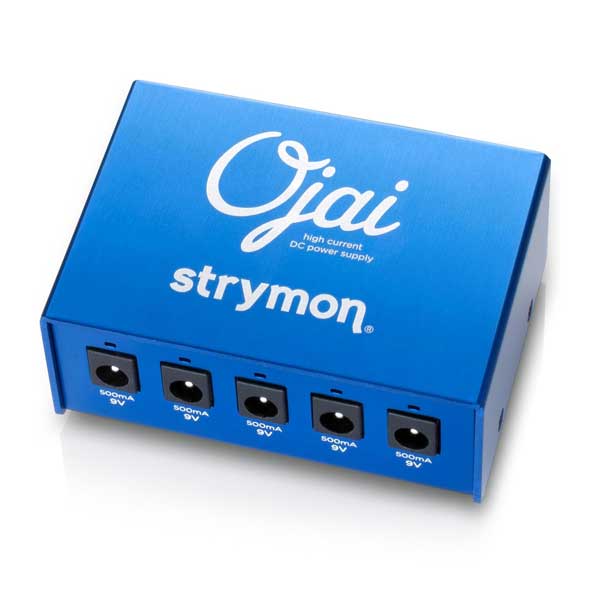
The Strymon Ojai power supplies have become a classic for pedalboards! They feature what one looks for in any power supply: minimal noise, high stability, and most importantly, efficient pedal isolation.
Another interesting feature is that it is possible to use several Strymon power supplies on a single power adapter. Thus, it’s possible to have two Strymon power supplies on one power socket. These are perfect if your pedalboard evolves over time.
The Strymon Zuma power supply is an alternative to the Strymon Ojai range for larger pedalboards. This power supply offers more outlets and other options.
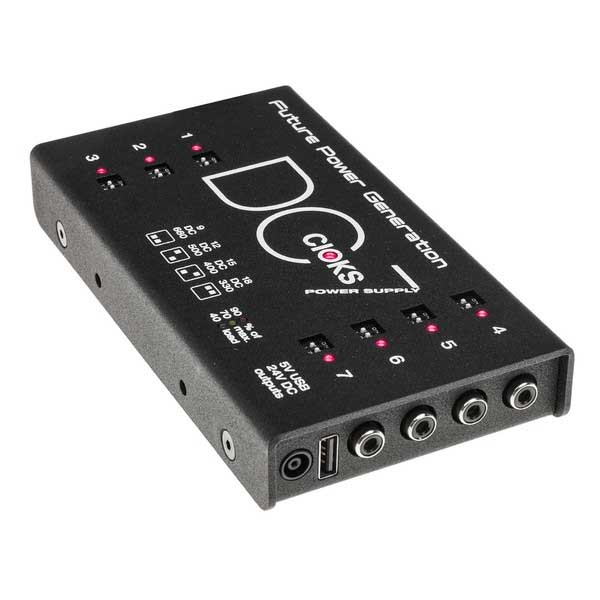
We have selected the Cioks DC7 power supply, which is the manufacturer’s most advanced model. There are other smaller power supply models or ones that can be combined with the modular DC7. Cioks products are known for their isolation. The DC7 has very compact dimensions, with a height of 1 inch (25.4mm) and a weight of only 1.1 pounds (500g). It features 7 outputs, each with 4 selectable voltages. So, you can choose between 9V 660mA, 12V 500mA, 15V 400mA or 18V 330mA. There is a smaller model called the CIOKS SOL which has 5 sockets.
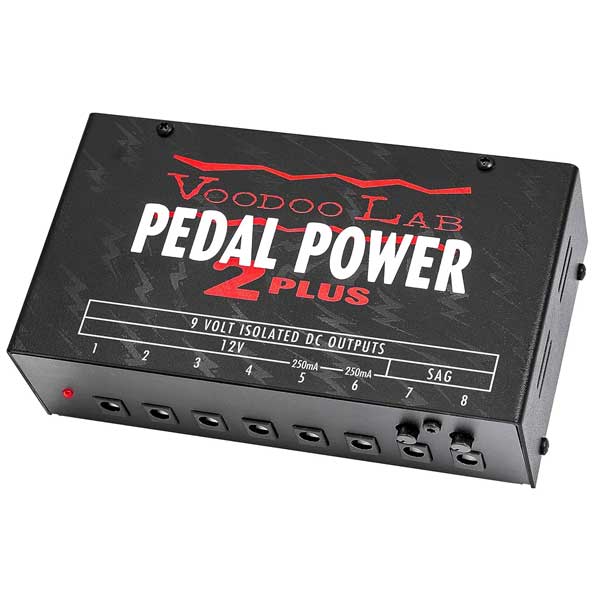
The Pedal Power 2 Plus power supply from Voodoo Lab is a very efficient model. It offers 8 isolated outlets, most of which can handle 100mA or 250mA. It is also a classic that has proven itself to many musicians. The Voodoo Lab Pedal Power 2 Plus is perfect for large pedalboards. It is more affordable than its competitors. It is a highly reliable product, stable and efficient. The 2 Plus model has 8 galvanically isolated 9V outputs, including 6 switchable 12V outputs and two 250 mA outputs for digital effects pedals. Of course, it can operate at 18V or 24V. The only small downside compared to previous models: the weight. It is 2 lb or 900g. Nevertheless, this power supply is much bulkier than the Strymon or Walrus models. It will therefore take up more space on the pedalboard.
In summary, while it’s possible to use a single power supply with a daisy chain to power a few analog pedals, this is not recommended if you have more than 3-4 pedals or if you use digital pedals. In this case, a high-quality power supply is essential to ensure the best possible sound!
Please remember that the products mentioned mostly come in higher and lower versions. The quality is often similar across the manufacturer’s ranges. Price increases and decreases are justified by the number of sockets and a few small options!
Sources: Voodoo, Walrus Audio, Strymon and Cioks
