
Beautiful Plants For Your Interior
Beautiful Plants For Your Interior

The sound produced by an electric musical instrument, such as a guitar, results from a chain of components and devices. This chain is susceptible to interference and noise. These interferences come from surrounding electronic devices or faulty electrical installations and can degrade the audio signal quality. For musicians, achieving an undistorted audio signal is crucial. This is where shielding becomes an essential solution, crucial for preserving audio quality. Why and how are electric guitar cavities shielded?
The goal of shielding is to preserve and transmit the guitar’s pure signal, without loss, alteration, or noise, from the instrument to the amplifier. It aims to minimize or eliminate external noise interference not inherent in the instrument’s audio output. This is achieved within the electric guitar’s cavity. The interior cavity is enveloped with conductive materials creating a protective barrier. This principle is analogous to Faraday’s Cage.
Shielding applies to all electric instruments. While this article focuses on electric guitars, electric cellos and electric violins also require this process.
A Faraday cage blocks electromagnetic fields. It’s a completely enclosed and airtight barrier against interference. The principle relies on the redistribution of electric charges within the Faraday cage material. Therefore, interferences do not reach the components inside the cavity; they are neutralized upon encountering the conductive material. Faraday cages are used to protect equipment sensitive to interference. The name “Faraday” is a tribute to Michael Faraday, a British physicist extensively involved in 19th-century electromagnetic and electrochemical industries.
This is a crucial step before shielding a musical instrument. If you experience no interference problems, shielding your guitar is unnecessary. If that is not the case, troubleshooting is required. Analyze all elements in the audio chain to identify sources of unwanted noise. Here are some troubleshooting steps:
Troubleshooting often involves eliminating components until the interference source is isolated. Multiple contributing factors are common. These problems can appear after years of guitar use; a weak solder connection or a loose wire can sometimes introduce parasitic noise.
This article focuses on shielding the instrument. If other equipment is generating the noise, contact that manufacturer’s customer service.
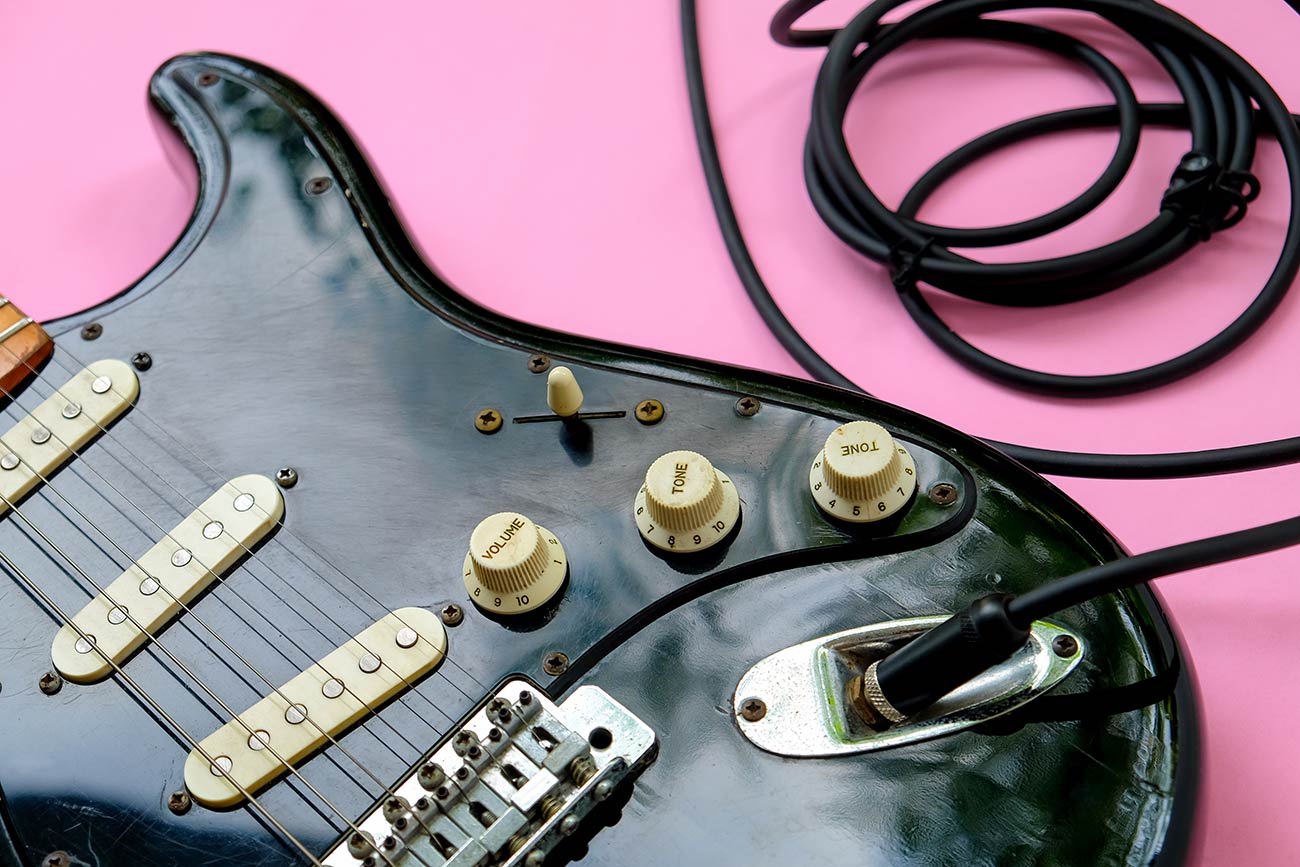
On electric guitars, electrical components are often clustered in a cavity. A Faraday cage around these components improves the signal-to-noise ratio, addressing guitar-produced noise. Conductive materials are inserted within the cavity to create a barrier, redirecting external interference away from these components.
Any cavity housing a component should be shielded. However, not all are. Pickups, potentiometers, and pickup selectors are cavities that often need shielding. Inadequate shielding can introduce buzzing. Completely perfect shielding is not always practical. For example, the pickup cavity is open and can’t be a perfect Faraday cage. However, shielding it to some degree can reduce interference.
Various conductive materials are suitable. Effective shielding depends on the material’s thickness and type. Magnetic paint, graphite, copper foil or tape, nickel, and aluminum are common choices. The critical factors here are shielding effectiveness, installation time, and cost-effectiveness.
Conductive paints are frequently used on entry-level models. They typically include copper, graphite, and silver, sometimes mixed with other materials. The luthier applies several layers to the interior of the cavity to create a Faraday cage. Copper tape or foil are also common applications; they’re placed inside the cavity and over the pickguard to achieve full coverage. Ensuring proper contact with the pickguard material is critical. Clean, well-planned internal wiring with consistent wire lengths follows.

Some luthiers use custom-cut aluminum sheets for enhanced shielding. Heavier materials, like iron, are less common due to added instrument weight, especially impacting instruments played on the shoulder (e.g., violins). Shielding shouldn’t significantly increase the instrument’s weight.
Continuity testing with a multimeter verifies shielding effectiveness.
Remember to re-test after reassembling the guitar to ensure all metallic components are connected: the output jack to the shield, the pickguard to the shield and so forth.
Effective shielding requires grounding. Without grounding, shielding is ineffective. This involves a metal washer and screw. Screw the washer through the shielded cavity wall, solder the screw wire to the guitar’s ground, and then check using a multimeter. If your chosen screw is painted, ensure you remove the paint from the screw’s metal head to ensure good contact with the wire.
This encompasses a broad range of potential sources. Interference can arise under various conditions. Every element in the audio chain can contribute to signal degradation.
The electrical system of an electric guitar is exposed to ambient electromagnetic radiation. The main elements generating a guitar’s signal (pickups, potentiometers, jack input, wiring, etc.) are sensitive to interference from nearby radio systems, mobile phones, transformers, dimmers, Wi-Fi networks, etc. This interference pollutes the signal, potentially degrading audio. One example is when a local radio station’s signal is picked up by the guitar’s amplifier.
Magnetic pickups, especially single-coil pickups, are particularly susceptible to magnetic interferences — this has fueled invention of humbucker pickups, designed precisely to minimize noise issues.
Shielding electric guitar cavities is more than a technical enhancement, but is essential for delivering clear, high-quality sound without interference and eliminating unwanted buzzing and noise. It’s a critical part of constructing and maintaining electric musical instruments and is relevant to any musician seeking to refine the signal quality. A luthier or any advanced musician can perform this maintenance.

