
Beautiful Plants For Your Interior
Beautiful Plants For Your Interior

Between us, let’s be honest! Effect pedals are not essential on an acoustic guitar or any acoustic instrument! The very principle of an acoustic instrument is to benefit from its unique tone that defines it! However, depending on the playing conditions, an acoustic guitar may need amplification! In this case, using effects can be a real asset to enhance the sound quality of the audio signal!
Acoustics is a science in itself. It studies the properties of vibrations in an environment capable of generating and propagating sounds.
The acoustic guitar has a soundbox. It acts as a “natural” amplifier to enhance the presence of what’s played. The sound waves then continue to propagate in the environment in which they are found. Every element involved in this sound diffusion chain plays a role in how the sounds are perceived.Why can acoustic properties disappear?
Electric guitars with a solid body do not have this ability to propagate sound. Without a soundbox, an amplification system must be used to hear what is played! Solidbody electric instruments truly need effects to add texture to their tone. Without effects, they have no presence; they are dry and direct! It is possible to play electric guitar without effects, but it is inconceivable for a guitarist! Why? Because the sound produced by an electric guitar without effects is of no interest!
However, it is possible to play acoustic guitar without effects! Many guitarists do this, and no one will be shocked by the sound produced!
Yes, but… everything depends on the playing situation in which the guitarist finds themselves!
Instruments were born acoustic! They have graced stages around the world without any amplification for centuries! Musicians performed in churches or small halls without plugging into any electric socket! However, the instruments were played in respect of certain harmony. Brass instruments and guitars were rarely combined because the power of the former would drown out the latter. Without amplification, an acoustic guitar cannot compete with a trumpet in terms of sound power. It was in the era of industrialization and globalization that the need for amplification emerged, with musicians eager to be heard. The advent of new musical genres pushed inventors to offer solutions to guitarists whose sound was inaudible next to a saxophone! Thus, amplifiers, pickups, and the first instruments incorporating these solutions appeared.
Amplifying an acoustic instrument depends on the playing situation! If a guitarist is playing in a small quartet of bowed string acoustic instruments in a church, it is very likely that none of these musicians will need amplification. The soundbox of the instruments, coupled with the reverberation offered by the venue, is sufficient.
If an acoustic guitar finds itself playing in a band using drums, bass, and a synthesizer, it absolutely needs to be amplified! The simple power of the soundbox cannot compete with a drum kit!
Here, the musician has two options: a microphone or a pickup. We wrote an article comparing the amplification of acoustic instruments. We recommend reading it if you’re not familiar with the advantages and disadvantages of each system. The article refers mostly to violins and cellos, but the case for the acoustic guitar is exactly the same!
In short, a microphone can amplify an acoustic guitar, but it has huge limitations and is not suitable for most situations due to feedback. The best solution remains the pickup. That’s why most acoustic guitars are equipped with a pickup! It’s installed on the instrument and has a jack output to connect to an amp.
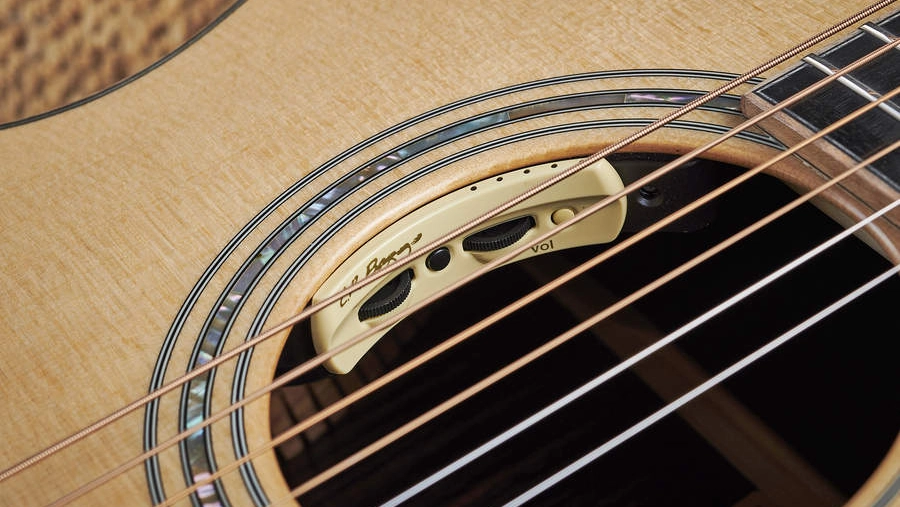
The problem with a pickup is that it cannot reproduce the natural tone of an acoustic instrument. Its sound production technique is based on the mechanical vibrations detected directly on the instrument. It does analyze the vibrations in the air. The system does not account for acoustics. Below is the LR Baggs Anthem pickup installed in the soundbox of a folk guitar.
If the guitarist uses a pickup to be heard, they are at the same level as an electric guitarist! They need effects to enhance their instrument’s tone.
An acoustic guitar amplified with a pickup doesn’t take acoustics into account! To reproduce it, you’ll use pedals called impulse response loaders. Impulse responses are acoustic imprints of instruments created by computerized mathematical calculations. They contain the acoustic essence of an instrument and are compiled into small audio files. When loaded into these pedals and applied to the signal, the pickup sound will benefit from the impulse response, transforming the signal and giving it acoustic characteristics it previously lacked. This system is currently the best way to recreate an acoustic tone. We offer impulse response files for guitars.
An equalizer allows you to work on the frequencies of an audio signal. It strengthens or attenuates certain frequency ranges, notably the bass, mids, and treble. These settings help to correct any sound defects, eliminate or highlight frequencies. The EQ is the tool for managing the instrument’s tone!
Reverb pedals aim to add depth to the signal to give the impression of playing in a room of varying sizes. Depending on the selected settings, the reverb pedal simulates the projection and reflections of sound vibrations within the simulated space.
A delay pedal works like an echo. That’s why many are called echo pedals! They add atmosphere and rhythm to your chords. They record and repeat what you play according to a set time. Almost every guitarist has a delay pedal on their pedalboard! It should be used in moderation, but its mere presence brings life to the sound produced by a pickup!
A preamp has the first tools to enhance the produced signal. Its primary benefit is amplifying the instrument’s audio signal. While a preamp is not essential, it greatly expands sound capabilities. Nowadays, most preamps are highly advanced. Some of them include frequency controls (EQ), tone management, signal compression, feedback detection tools, IR loader, reverb, and many other features.
A preamp is a great first investment, possibly preventing multiple expenses as it combines the effects mentioned earlier.
The tuner is not an effect pedal, but it is a really basic pedal to have on your pedalboard! Tuner pedals simplify instrument tuning with a chromatic tuner. Whatever string instrument you play, a tuner is a must-have tool on stage! As a professional, you must ensure your instrument is always in tune!
Tuner pedals feature a bypass mode. This means they have no effect on the rest of the signal. It’s placed first on the pedalboard to have maximum precision during tuning!
We selected more effects for acoustic guitarists in this article!
Among the pedals listed above, the first element to place is the tuner. It always comes first because it must detect the signal in its original form.
The rest of the elements are subject to debate. If you use a preamp, we suggest placing it after the tuner. Its main role is to amplify the signal so it can be more easily processed by the following effects. Depending on the settings offered by the preamp, you are free to then follow with the IR loader, EQ, reverb, and delay. Some musicians prefer to adjust their EQ at the beginning of the chain, while others prefer it at the end. Keep in mind that there are no strict rules when it comes to effect order! It all depends on what you are looking for. It’s recommended to experiment and choose what suits your taste best!
There are many other pedals you can use to transform the sound of an acoustic guitar. If your goal is to preserve your instrument’s acoustic tone, these few pedals are an excellent start for enhancing the produced audio signal.

