
Beautiful Plants For Your Interior
Beautiful Plants For Your Interior
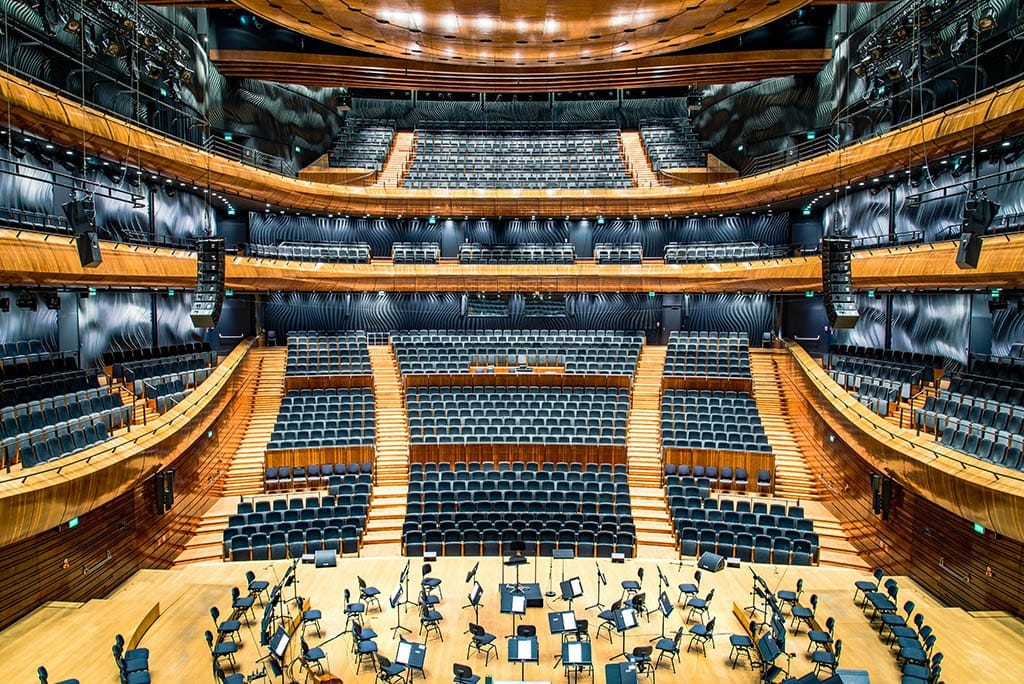
Convolution reverb is recognized and used in many professional fields related to sound production. It is of particular interest due to its technological approach, which allows it to faithfully reproduce the acoustic ambience of spaces. Unlike algorithmic reverb, convolution reverb uses impulse responses to reconstruct acoustics.
Reverb is an acoustic phenomenon that occurs organically in acoustic environments, where sound is reflected by surfaces and objects, generating multiple acoustic reflections.
In music, reverb is an audio effect created artificially to replicate the natural phenomenon described above. In this case, reverb aims to add ambiance and depth to a sound recording. We called it also algorithmic reverberation, because it is generated by a computer. Reverb is the result of multiple sound reflections off surfaces. It uses mathematical formulas based on parameters to synthesize reverberation. Parameters are relative to a space. They allow us to characterize its size, shape, wave diffusion and reflection capacity, etc. They are also defined as a function of time. The list of parameters is large, which allows us to generate many different reverberations.
Algorithmic reverberation is the result of multiple reflections of sound on the surfaces of the designated space. Reverb effects can vary based on different parameters such as reverb duration, reflection intensity, simulated environment type, etc. It adds dimension to an audio recording, simulating the acoustics of venues such as concert halls, churches, studios, or any other environment. Reverb can be used to create a warm and natural ambiance, make a recording more spacious and immersive, or add a particular atmosphere to a musical composition. It is widely used in various music genres, from classical to rock to electronic, to create rich and complex sounds.
These reverb effects are based on algorithmic systems synthesizing the characteristics and rendering of reverberation.
Convolution reverb is a specific form of reverb effect that uses convolution technology to reproduce the acoustics of an environment. Unlike traditional algorithm-based reverbs, convolution reverb uses audio recordings called impulse responses. These audio files are “soundprints” of acoustic environments, allowing the replication of the original environment’s acoustics through an audio signal. When you apply an impulse response file to an audio signal, you simulate the characteristics of the captured location.
The convolution reverb sounds more realistic because it includes a higher density of reflections than algorithmic reverb.
Impulse Response, or IR, are used in many works. In audio production, an impulse response is the reaction of any system (environment, amps, instruments, etc.) in response to some external change. They are the recording of sound reflections that occur through the system. They allow for the simulation of the acoustic characteristics of a system through a series of mathematical processes.
The process of convolution reverb is quite simple. Let’s explore how it works!
Let’s take a fairly simple example. You recorded your guitar in the studio using a pickup. However, in post-production, you want to give your instrument’s audio signal a specific timbre by adding a reverb that simulates the acoustics of a large space with broad reflections.
To add that sense of wide open space to your signal, you first need to define it. You can try impulse response files of cathedrals, churches, or possibly a large natural space. To create convolution reverb, a short audio impulse captured in particular conditions within a space is used. This can be a concert hall, a cathedral, or a studio. This impulse is typically a short, sharp sound contained in a small audio file. When heard, an impulse response sounds like a short clap lasting a few seconds.

Let’s see how to apply this impulse response file to your signal. The impulse response file must be added and then interpreted by software or a device. To apply this IR file, a processor must perform mathematical calculations. This is why you need DAW software like Ableton or ProTools, or a dedicated effects pedal. This impulse is then used as a ‘filter’ to shape the original sound. Each small part of this sound is transformed using the recorded impulse, which mimics the echoes and ambiance of the place where the impulse was captured. To do this, precise mathematical tools are used.
Before being heard, the result is calculated by a computer processor. The final sound represents a reverb that faithfully reproduces the acoustic characteristics of the recorded environment applied to the source audio signal. This includes room size, resonance, reflections, and all other characteristics that give meaning to the reverb. The final rendering is often very realistic, producing immersive and lifelike sound.
Convolution reverbs are appreciated for their ability to realistically reproduce the acoustics of real spaces, making them popular in professional audio applications such as music production, sound mixing for film, audio post-production, and more. They offer great flexibility and sonic accuracy, allowing sound engineers and producers to create compelling and realistic sound environments. They allow engineers to simulate convincing and realistic sound environments from a simple audio signal.
In filmmaking, when shooting a scene against a green screen or LED panels, a visual space is simulated using technology. Similarly to the image, when recording audio, we cannot capture a realistic audio environment. We capture the actual sound environment. If the scene takes place inside a theater, the natural reverberation of that space will be missing. We will therefore simulate it using convolution reverb. To do this, we apply the impulse response of a similar location to the audio signal to give it specific characteristics.
The main disadvantage of convolution reverb is that it is a fairly computationally intensive system. It requires more resources than algorithmic reverb. It also depends on the quality of the impulse response files used.
Convolution involves a mathematical process combining two signals to produce a third. In the case of convolution reverb, the first signals are the source audio signal (also called the input signal) and the impulse response (also called the response function).
The mathematical process multiplies the points of the source signal with those of the impulse response. Then, the multiplication of these points is added according to temporal evolutions and shifts. This yields a series of partial sums of the signals representing the contribution of each starting signal. The result of convolution produces a new audio signal (the convolved signal). It represents the combination of the input and response signal characteristics.
In simpler terms, and in a musical context, a convolution reverb plugin will use the source audio signal and multiply it by the impulse response signal. This process applies the acoustic imprint contained in the impulse response signal to the source audio signal. If the impulse response is the acoustic imprint of a cathedral, the acoustic reverb of that same cathedral will be applied to the source signal. It blends samples from an environment’s IR with the source signal.
Convolution reverb plugins or effects can be found in all DAWs, sound processing software, effects processors, and other devices. Some plugins are integrated into software, while others can be downloaded and used through the DAW (plugins). They all offer more or less the same configuration characteristics and adjustable parameters (reverb duration, low and high-frequency definition, source distance and position, etc.). Some have the advantage of coming with a database of impulse responses. If not, impulse responses can be purchased. We offer impulse responses for acoustic instruments such as violins or cellos.
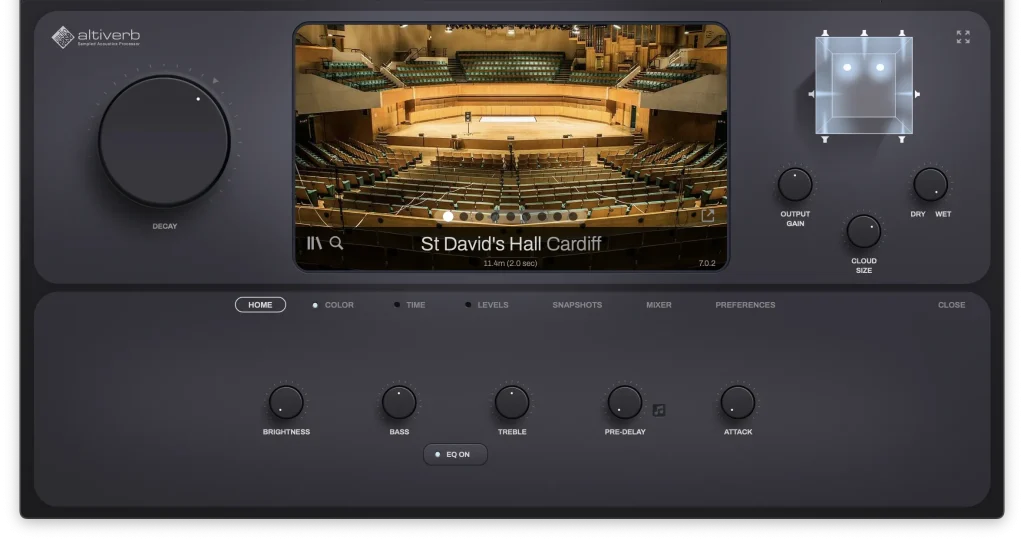
Indeed, we have talked a lot about the acoustic imprint of places and environments. But impulse responses can be applied to many elements including acoustic instruments or amplifiers. Many guitarists use impulse responses to reproduce the sound of legendary amplifiers, while violinists and cellists use them to simulate the instrument’s acoustics when the signal is captured using a pickup.
Convolution reverberation has established itself as the solution for sound professionals seeking a faithful reproduction of environmental acoustics. It is applied in a wide variety of fields, always with the same goal in mind: the most faithful possible acoustic reproduction of a location, device, or object such as a musical instrument.

