
Beautiful Plants For Your Interior
Beautiful Plants For Your Interior
Vibrato, an iconic sound effect, holds a special place in the world of modulation and musical instruments. Blending instrumental skill and technological innovation, vibrato creates subtle or dramatic pitch fluctuations. From classical opera to rock concerts, vibrato is a versatile effect used by musicians around the world.
Vibrato is an effect that belongs to the family of modulation effects, like tremolo or chorus. While many modulation effects share similarities, it’s important to note that each modulation effect has its own technical characteristics and produces its effect in a unique way. Vibrato is achieved by applying modulation to the pitch of the input signal.
The term “vibrato” comes from the Italian word “vibrare” meaning “to vibrate.” In Italian, the vibrato is generally associated with singing and the technique employed by singers to vibrate their vocal cords. It is a vocal technique used by opera singers to add body and richness to their voices.
For instrumentalists, “vibrato” is also a technique. Violinists and guitarists use it by moving their fingers on the fretboard of their instrument on the same note to generate the effect. Vibrato is also found in the brass family of instruments: trombones, flutes, trumpets, etc. However, it is not produced in the same way. In this case, musicians use a breath technique, while for stringed instruments, it is a physical technique.
As with tremolo, the history of vibrato is quite confusing due to the terminology used by some manufacturers. For marketing purposes, they have reversed certain names, which still misleads many musicians.
For example, when electric guitar manufacturer Leo Fender released his Stratocaster, it was equipped with a tremolo arm called the “Tremolo Action Lever“. However, this arm is not a tremolo… but a vibrato since the lever affects the pitch of the notes, not the volume of the signal! This vibrato is mechanical and does not rely on any electronic circuitry! By pressing the lever, the bridge is lowered and raised to tighten and loosen the strings between the bridge and the nut of the guitar, which changes the pitch of the string!
Fender also released amplifiers with the name “Vibrato“. However, they were not equipped with a vibrato, but with a tremolo. In short, these successive misleading names have ended up confusing users, and it’s easy to understand why!
Before the advent of a vibrato pedal, there were many “vibrato effects” first housed in wooden boxes and then integrated into amplifiers. However, the manufacturing costs were high, making these devices difficult to acquire. This changed in 1968 when Japanese engineer Fumio Mieda invented the Uni-Vibe pedal. This device was marketed by the company Shin-ei. The image below shows the Uni-Vibe alongside a Vibe-2 pedal that allowed the speed to be controlled with the foot (Wikipedia photo).
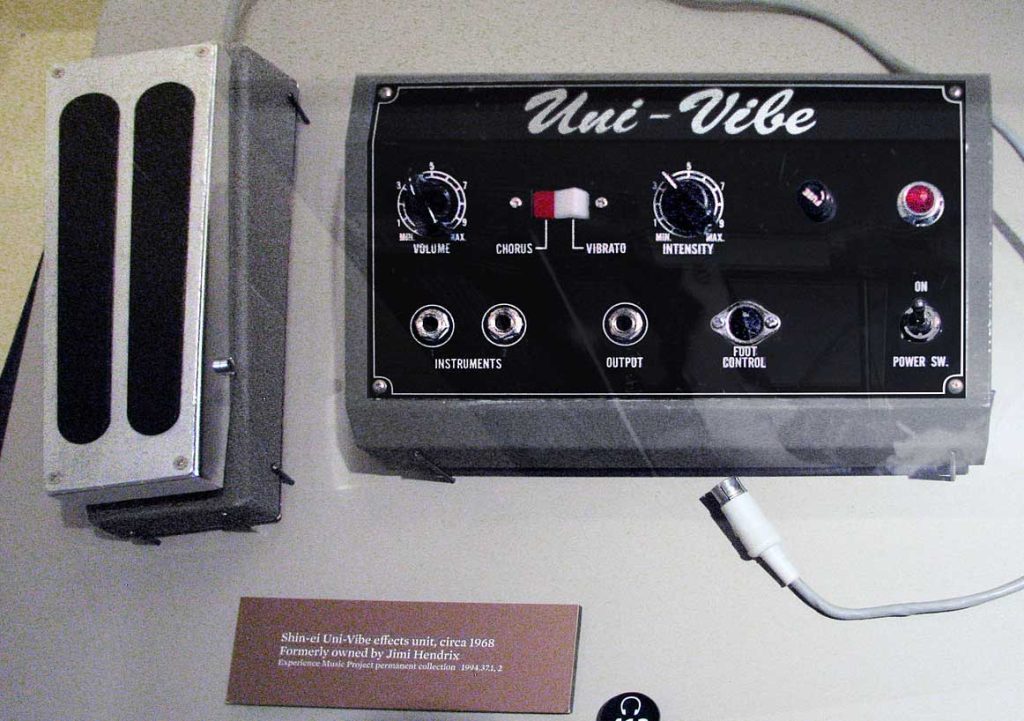
The Uni-Vibe was marketed as a device capable of transforming the sound of any electric musical instrument with vibrato and chorus effects. The Uni-Vibe indeed featured both vibrato and chorus capabilities, and its original commercial name was even “Vibra Chorus“. A key feature of the Uni-Vibe was its use of affordable electronic components, making it more accessible to a wider range of users. Fumio Mieda, the inventor of the Uni-Vibe, replaced tube components with transistors, significantly reducing production costs.
Guitarist Jimmy Hendrix was among the first to adopt the Uni-Vibe pedal. Interestingly, Fumio Mieda recounts in an interview that he saw images of Jimmy Hendrix performing at Woodstock but was unaware that Hendrix was using his Uni-Vibe. He only learned about it much later!
Following the Uni-Vibe’s success, vibrato was often combined with other effects like chorus or flanger, resulting in new devices. Brands promoted these pedals primarily based on the most popular effect at the time, which wasn’t vibrato. It wasn’t until the early 1980s that Boss introduced the VB-2 Vibrato pedal, becoming the first (or one of the first) brands to release a pedal dedicated solely to vibrato. Other manufacturers followed suit, and numerous vibrato pedal models emerged. Naturally, the evolution of pedals led to a variety of distinct sounds. The Uni-Vibe is such a unique pedal that it’s often considered an effect category in its own right. All specialized pedal effect websites distinguish vibrato from Uni-vibe, also known as Vibe.
If you want to know more about the history of vibrato, we advise you to read this article which is by far the most detailed there is!
Identifying vibrato in a song can be challenging because many effects produce similar sounds. Depending on the intensity of the effect, it’s easy to confuse tremolo, vibrato, or Uni-Vibe. Here are a few examples where pitch modulation is evident.
In the realm of modulation effects, vibrato and tremolo often cause confusion due to their shared ability to create a sense of movement and rhythm in the sound. However, the mechanisms behind these effects are fundamentally different. Vibrato applies modulation to the pitch of the signal, while tremolo modulates the signal’s volume.
Vibrato and chorus share some similarities, but there are also key distinctions. Both effects involve pitch modulation, but chorus adds an extra layer of complexity by introducing a slight delay and detuning to the modulated signal. This creates a thicker, more spacious sound compared to vibrato’s subtle pitch variation.
The modulation of a vibrato is done at the level of the pitch of the signal. The pitch of notes oscillates when played.
Pitch
Creating a “warbling” effect
Adding expression and depth to solos
Creating a psychedelic feel
Tremolo modulation applies the volume of the signal to increase and decrease repeatedly.
Volume
Creating a “trembling” effect
Thickening the sound
The chorus divides the signal in two. It preserves the first signal and applies modulation to the second signal. The modulation is done at the level of the height of the signal to which it also adds a slight delay.
Pitch + delay
Thicker, more spacious sound
Creating a lush, layered sound
Simulating a double-tracked instrument
Vibrato alters the pitch of the signal to generate a modulation effect. This creates a repetitive, rhythmic movement in pitch, giving the impression of notes oscillating in pitch. The modulation also introduces variations in “loudness,” as some notes become more prominent while others recede slightly.
Vibrato pedals typically feature at least two main controls:
Some models also offer a “rise/rise time” control, which governs the speed at which the modulation transitions between the original pitch and the modulated pitch. Expression pedals can be effectively used in conjunction with vibrato and vibe effects to dynamically control this modulation speed.
Vibrato remains a widely used effect in modern music production, finding its place in various genres, including rock, electronic music, pop, and more. Depending on the musical context, it can be employed subtly to achieve a natural and expressive sound, or pushed to its extremes to create a more outlandish and attention-grabbing effect.
While vibrato is not as widely used as chorus, tremolo, or phaser, there are still some great vibrato pedals available. Here are four options that offer interesting features and cater to different budgets:
Clearly, if you can afford it, the Diamond Vibrato is the ultimate vibrato model! For a tight budget, you won’t find better than the Behringer UV300 Ultra Vibrato!
Vibrato VST plugins are relatively rare, as vibrato can often be achieved with a chorus plugin. If you have a chorus plugin, look at the options it offers. It’s quite possible that you can get a vibrato with it. However, there are a few dedicated vibrato plugins available:
Whether applied manually by performers or enhanced by electronic devices, vibrato creates distinct sonic environments. Vibrato is a vehicle of musical expression, capable of captivating both amateur and professional musicians.
