
Beautiful Plants For Your Interior
Beautiful Plants For Your Interior

Understanding the different guitar tuning systems requires a minimum of reference points to avoid getting lost in the multitude of existing variations. Scientific Pitch Notation (SPN) provides this frame of reference by associating each note with its register using a clear and universal numbering. Through this memo, you will discover not only the logic of this notation, but also an overview of the main guitar tunings, from the most classic (E-A-D-G-B-E, or E standard tuning) to the most extreme (like Drop D, Drop A or C#).
The octave numbers are based on the SPN (Scientific Pitch Notation), also known as ASPN (American standard pitch notation) or IPN (International Pitch Notation). It’s a system used to accurately name musical notes by indicating both their name and their register. It combines a letter corresponding to the note (from A to G) and a number designating the octave. For example, A4 corresponds to the frequency of 440 Hz, which is the international reference for tuning.
This notation has the advantage of avoiding any ambiguity: it allows a clear distinction between a low note, such as C2, and a high note, such as C6.
Find the table of color codes used for each octave. These color code are then used in each table representing a kind of tuning.
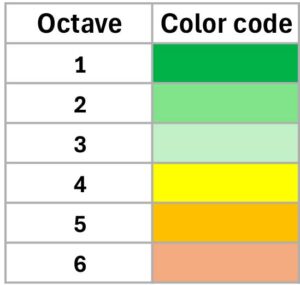
Each chart lists the strings and the progression of the notes. Octaves use the color codes mentioned above. If you identify an error, please let us know by using our contact form. Thanks!
The standard guitar tuning, often noted E-A-D-G-B-E (or E2-A2-D3-G3-B3-E4), is the universal benchmark for guitars. Tuning in E is based on the E major and minor scales.
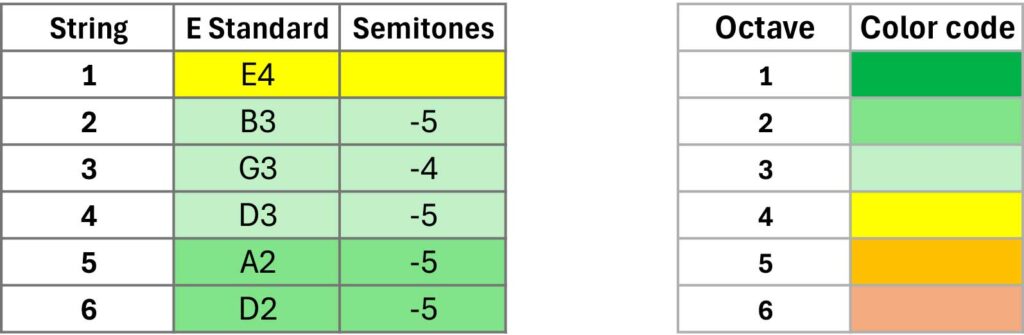
This tuning is favored for its clarity and simplicity, allowing for both rhythmic accompaniment and solos. It is the tuning most guitarists learn first, and the one in which the majority of classic modern guitar pieces are composed. It forms the basis for practically all musical styles, from rock to jazz.

Here is a few songs using a Drop D tuning: Ride The Lightning by Metallica, Stairway to Heaven by Led Zeppelin, Blackbird by The Beatles, and Hotel California by Eagles.
By lowering each string by a half-step (D#-G#-C#-F#-A#-D#, or D#2-G#2-C#3-F#3-A#3-D#4), the guitar gains warmth and depth. This tuning, popularized by Jimi Hendrix and Stevie Ray Vaughan, makes bends easier to play and softens string tension, while bringing a darker, more expressive character to the sound.

Here is a few songs using a Drop D tuning: Purple Haze and Machine Gun by Jimi Hendrix, Pride and Joy by Stevie Ray Vaughan, or Smells Like Teen Spirit by Nirvana.
Drop D (D-A-D-G-B-E, or D2-A2-D3-G3-B3-E4) consists of lowering only the sixth string by a whole tone. This provides powerful low notes and allows for one-finger bar chords. Widely used in rock, metal, and grunge, this tuning provides a punchy rhythmic foundation. We edited a dedicated article on Drop D tuning for guitars that we invite you to read.

Here is a few songs using a Drop D tuning: Everlong by Foo Fighters, Killing in the Name by Rage Against the Machine, Black by Pearl Jam, or Heart-Shaped Box by Nirvana.
By lowering each string by a full tone (D-G-C-F-A-D or D2-G2-C3-F3-A3-D4), the guitar moves into a lower register. This tuning maintains the logic of the usual fingerings but delivers a heavier, deeper resonance. It is found particularly in heavy metal and folk.

Here is a few songs using a D standard tuning: Yesterday by The Beatles, Budapest by George Ezra, Come As You Are by Nirvana, or Walk by Pantera.
With the lowest string dropped by a whole tone and a half, and the others by a full tone (C#-G#-C#-F#-A#-D#, or C#2-G#2-C#3-F#3-A#3-D#4), Drop C# sits between Drop D and Drop C. It provides an interesting compromise: a massive yet still fairly clear sound, often used in alternative metal.

Here is a few songs using a Drop C# tuning: Them bones by Alice in Chains, Life In A Jar by Superheaven, Regular John by Queens of the stone age.
Very common in modern metal, Drop C (C-G-C-F-A-D, or C2-G2-C3-F3-A3-D4) offers impressive sonic power. This tuning delivers a heavy, aggressive, and cutting sound, ideal for palm-muted riffs and fast rhythms.

Songs using a Drop C tuning: Before I Forget by Slipknot, Chop Suey! by System of a Down or Bodies by Drowning Pool.
By lowering all strings by a tone and a half (C#-F#-B-E-G#-C#, or C#2-F#2-B2-E3-G#3-C#3), the guitar is tuned lower while retaining classic positions. This low register is appreciated in rock and metal because it maintains great harmonic clarity despite the drop.

C Standard tuning (C-F-A#-D#-G-C, or C2-F2-A#2-D#3-G3-C4) lowers all strings by two full tones. It allows for the preservation of usual fingerings while exploring a deeper sonic spectrum. It is found in doom metal bands as well as in certain acoustic approaches.

Here is a few songs using the C standard tuning: Static-X for tracks like Push It and Dirthouse, Hatebreed for songs such as I Will Be Heard, and Arch Enemy for songs like Enemy Within.
With Drop B (B-F#-B-E-G#-C#, or B1-F#2-B2-E3-G#3-C#4), the guitar ventures into an extremely heavy register. This tuning is a benchmark in metalcore and death metal, offering powerful riffs and a sonic depth that highlights the sixth string, which is tuned down to a low B.

Here is a few songs using a Drop B tuning: Shed by Title Fight, Duality by Slipknot, or Knives by Bullet For My Valentine.
Tuning in B (B-E-A-D-F#-B, or B1-E2-A2-D3-F#3-B3) is even lower than C Standard. It maintains a standard organization but offers an extremely dark and heavy sound. It is often found in doom and death metal.

Listen I Don’t Wanna Be Me by Type O Negative, or Runaway by Linkin Park to discover this tuning.
Drop A (A-E-A-D-F#-B, or A1-E2-A2-D3-F#3-B3) is a very popular tuning in modern metal. It allows for playing ultra-low riffs while keeping the classic reference points. Its massive and saturated register makes it a formidable weapon for technical rhythms.

Here is a few songs using a Drop A tuning: The Heretic Anthem by Slipknot, Guardians of Asgaard by Amon Amarth, and several tracks by bands like Emmure, Make Them Suffer, Suicide Silence, and Thy Art Is Murde.
On a seven-string guitar, the standard tuning is B-E-A-D-G-B-E (or B1-E2-A2-D3-G3-B3-E4). The extra low B string opens up new harmonic and melodic possibilities. Highly valued by jazz and metal guitarists, it combines harmonic richness and power. We edited an article about the origins of 7 and 8-string electric guitars.

With eight strings, the most common tuning is F#-B-E-A-D-G-B-E (or F#1-B1-E2-A2-D3-G3-B3-E4). The additional low F# string pushes the guitar towards sonic depths close to the bass. This tuning is central to djent and progressive metal, where the search for an extended range is paramount.
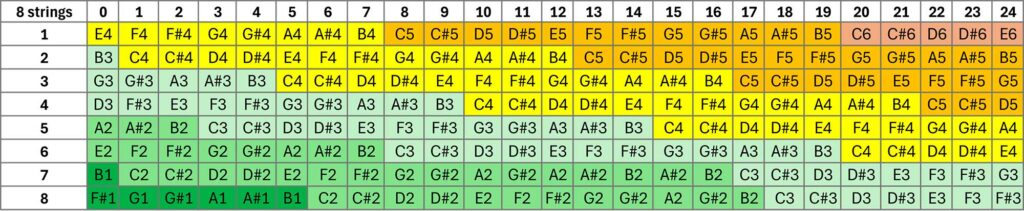
See below a quick resume for each tuning.
| Tuning | Normal notation | Notation using SPN |
|---|---|---|
| E Standard | E-A-D-G-B-E | E2-A2-D3-G3-B3-E4 |
| E Flat | D#-G#-C#-F#-A#-D# | D#2-G#2-C#3-F#3-A#3-D#4 |
| D Tuning | D-G-C-F-A-D | D2-G2-C3-F3-A3-D4 |
| Drop D | D-A-D-G-B-E | D2-G2-C3-F3-A3-D4 |
| C Tuning | C-F-A#-D#-G-C | C2-F2-A#2-D#3-G3-C4 |
| C# | C#-F#-B-E-G#-C# | C#2-F#2-B2-E3-G#3-C#3 |
| Drop C# | C#-G#-C#-F#-A#-D# | C#2-G#2-C#3-F#3-A#3-D#4 |
| Drop C | C-G-C-F-A-D | C2-G2-C3-F3-A3-D4 |
| B Tuning | B-E-A-D-F#-B | B1-E2-A2-D3-F#3-B3 |
| Drop B | B-F#-B-E-G#-C# | B1-F#2-B2-E3-G#3-C#4 |
| 7-string guitar Standard Tuning | B-E-A-D-G-B-E | B1-E2-A2-D3-G3-B3-E4 |
| 8-string guitar Standard Tuning | F#-B-E-A-D-G-B-E | F#1-B1-E2-A2-D3-G3-B3-E4 |
| 9-string guitar Standard Tuning | C#-F#-B-E-A-D-G-B-E | C#1-F#1-B1-E2-A2-D3-G3-B3-E4 |
Thanks to Scientific Pitch Notation, it becomes possible to navigate more easily in this constantly evolving universe, while maintaining a common and precise reference.

