
Beautiful Plants For Your Interior
Beautiful Plants For Your Interior
Choosing the right equipment to define your audio signal and the timbre of your instrument is an important step for any studio or stage musician. We are always in search of that ideal sound, with its specific grain, the one that defines us as musicians. There are thousands of devices to achieve this, but multi-effects processors are increasingly popular for their features and because they are portable compared to a large rack of small pedals! When choosing a processor, always aim for one that can use impulse response files, otherwise, you will be cutting yourself off from one of the most interesting possibilities offered by these units.
Before getting started, you need to understand a few key characteristics to use IR (Impulse Response) files with effects processors. There are specific details and vocabulary you should know to avoid getting lost.
An effects processor is an electronic device that allows musicians to modify and enhance the sound of their electric or acoustic instrument by applying various effects (delay, reverb, distortion, overdrive, chorus, etc.). An effects processor is an essential tool for musicians!
An Impulse Response (IR) file is an audio file containing the sonic imprint of an audio system (amp, speaker, preamp, microphone) or an acoustic space. Using various mathematical processes, this file applies the acoustic characteristics of the captured element to an original signal.
Some effects processor manufacturers provide impulse response files that are directly integrated into the device. They also allow the insertion of other IR files. The majority of effects processors available on the market are compatible with IR files edited by 3rd party companies.
3rd party IR files are created by various companies, musicians, or music enthusiasts (like us). Most of the time, they are encoded in WAV format, making them usable by almost all software and devices.
These units support Impulse Response files as long as they are in WAV format and adhere to a certain bitrate. Note that if this bitrate exceeds the processing capabilities of the processor, it will adjust your file accordingly (generally). This information is readily available in your device’s manual or directly on the manufacturer’s website.
Using IR (Impulse Response) files when composing a track or performing live is a significant decision. An impulse response is a type of equalization (EQ) curve applied to the signal from the amplifier. (Note: It’s not an actual EQ; we’re using this term for comparison so you can properly understand an IR’s purpose.) It not only shapes the tone but also determines how the sound will fit into the mix. Choosing the right impulse response is a crucial step! Knowing and mastering impulse responses, and selecting the right file from the start of a project, will save you time.
Musicians use various multi-effects processors offered by numerous manufacturers including Line 6, Boss, Zoom, Hotone or Kemper.
The majority of effects processors offer excellent sound results. Naturally, the budget allocated to the device is one of the first indicators of the processor’s quality. However, very good devices are available in entry-level ranges. User feedback and reviews, especially from your friends, should guide you towards this brand and range.
In the market, there are processors dedicated to electric guitars, basses, and acoustic guitars. Regardless of your instrument, each processor can be adapted to your needs. It’s important to tailor the presets to your requirements and the frequencies of your instrument.
Here is a non-exhaustive list of processors we have tested in the past. They all accept 3rd party IR files.
The HX Stomp is a small effects processor with the best technology than the Helix Floor. It has the same effect modules and impulse responses. However, it has fewer adjustment buttons and no longer has an expression pedal. You have to add one in parallel if necessary!
The processor offers excellent sound quality. On the other hand, getting started can be a little complicated at first. Line 6 offers a wide range of effects processors that are very qualitative! Updates are frequent and relevant! Line 6 is offering many effects processors! Have a look to find one on your budget! Line 6 offers more processors, all excellent, but we really like this small unit. You can have a look on the Helix family (very expensive, but insane units), and the POD GO processors are good too.
PROS
Great processor
Can combine and blend IRs
Use high bitrate .wav IR file
Good user interface
Huge number of patches
CONS
Cost
Hard to use at the beginning

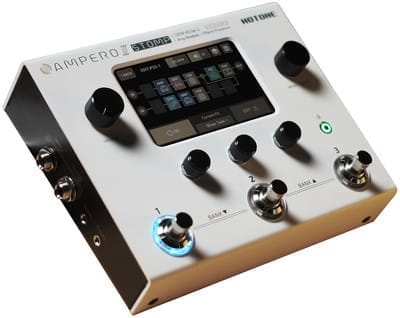
The Ampero II Stomp is a processor with an excellent quality/price ratio! It has multiple processors, a large bank of pre-integrated effects and numerous possibilities for customization.
It integrates a plethora of impulse responses for guitars, speakers and amps. Like the HX Stomp, an expression pedal is to be expected if necessary because the processor does not have one. We really appreciate the sound quality offered by this product! Small downside on the Hotone software which has a few bugs. Ampero Stage processors are also excellent products, and the new Hotone Ampero II is insane!
PROS
Can combine and blend IRs
Use high bitrate .wav IR file
Easy to use
Huge number of patches
Good sound for the price
CONS
Bad interface between the computer and the unit
Not a lot of updates
The HeadRush company is a little less recognized than Line 6 or Boss. However, it has managed to make a nice place for itself in the world of effects processors. The Prime effects processor is an excellent product that delights many users. The interface is surprisingly easy to use. This processor has a wah pedal. It is possible to integrate an expression pedal on the dedicated input. It has many IRs for guitars, speakers and amplifiers. However, we regret the quality of certain effects. It is sometimes necessary to rework them so that the sound becomes coherent. The HeadRush Core processor is also a good option!
PROS
Can combine and blend IRs
Very intuitive UX/UI
Great sound
With an expressive pedal
CONS
All presets do not have the same audio quality

The ME-90 processor is one of the latest additions to Boss. It offers exceptional sound quality thanks to a 24-bit AD/DA converter. It has the essential elements: effects loops, multiple effects, amp simulation, etc. It is not our favorite product, but well, many people like it!
PROS
Price
High bitrate IR files
Robust
With an expressive pedal
CONS
Only 3 x 3rd party IR files
No IR blending
Need to buy more device to use a phone app
Less possibilities compared to the 4 other processors

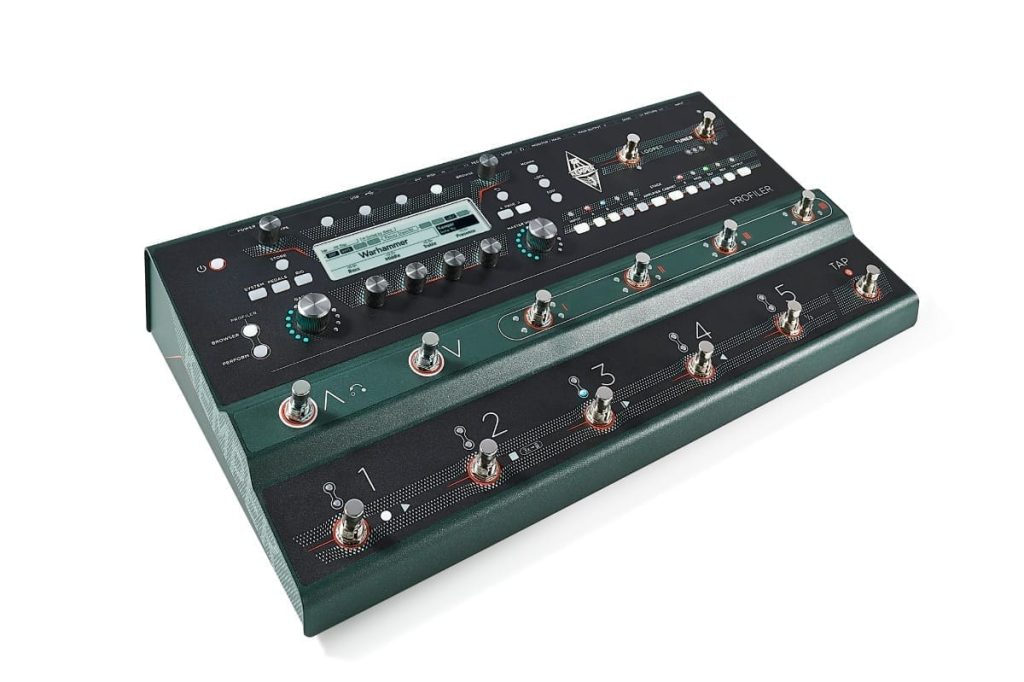
With Kemper, it is difficult to be disappointed! The products offered are always very qualitative in every way! The Kemper Profiler Stage has won over many stage guitarists! It is equivalent to the Profiler Head but with a more portable design.
Of course, for such quality, you have to have a very large budget. The Kemper Profiler Stage costs around $1,500 (USD). It is a bit like the best of the best processors!
PROS
One of the best processor on the market
High bitrate IR files
Robust
Endless tone possibilities
CONS
Price
Very small screen
Hard to use
Integration of IR files on such devices is done using the software provided by the manufacturer. These software tools can be downloaded for free from the manufacturers’ websites. Don’t hesitate to update your device’s firmware. We have detailed in this article the integration of Impulse Response files with a Line 6 processor, Hotone Audio and Zoom. For other brands, feel free to search the manufacturers’ forums or simply on YouTube, which is full of videos about this topic.
It is highly recommended to work on your IR module, and then the entire FX chain. The IR file will transform the produced sound, but the signal can be greatly enhanced with additional effects. We strongly recommend using equalizers and any other effects you find useful in your effects chain (reverb, delay by example).
The construction of an effects chain results from personal choices. There are no right or wrong outcomes. The most important thing is to find a final sound that suits you!
Generally, IR files are positioned at their logical location in a sound chain. Indeed, if you want to use an impulse response from an amp, it makes sense to position it at the end of the effects chain. The IR module takes the place that this amplifier would have had if you had owned it. The same goes for all other IRs. Therefore, at the end of the effects chain, we find IRs from cabinets, amps, microphones used to capture the sound of an amp, or even environments. On the other hand, IR files of acoustic instruments are positioned at the beginning of the effects chain since they represent the acoustic characteristics of these musical instruments.
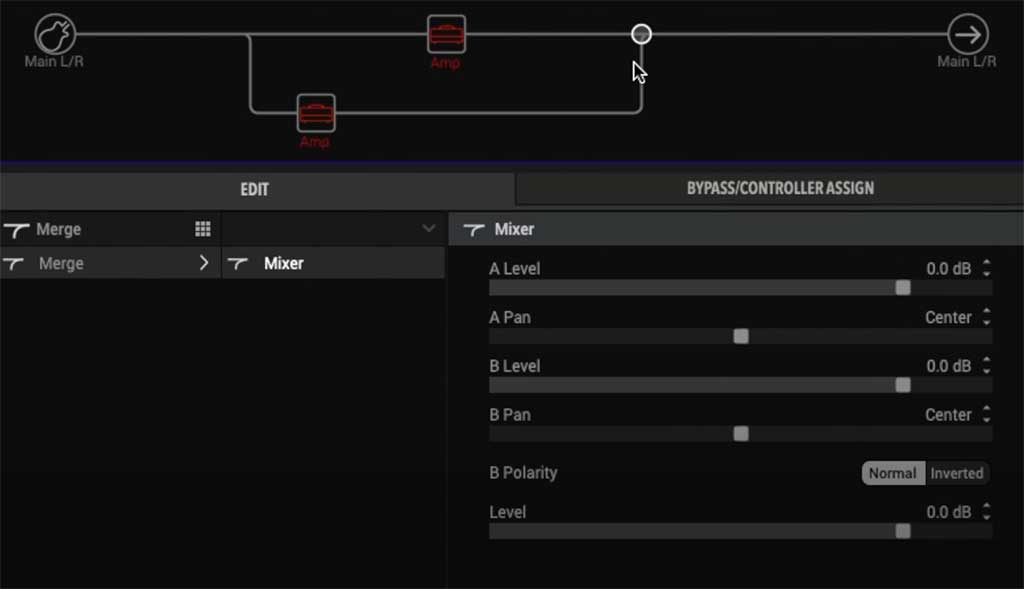
If your processor allows it, we recommend trying IR blending within the same preset. This process enables you to explore new tones for your guitar by combining multiple impulse response files. Below is an example of blending two IR files by using a Line 6 Helix Floor processor.
Mastering these tools isn’t about becoming a sound engineer; it’s about taking control of your music. Don’t buy an expensive processors if you don’t have the budget. Even the first range can help you to define your tone by using 3rd party IR files! With these files, you’re no longer limited by what your physical gear can do. You can use digital amps, cabs, mic and acoustic tones.
Sources: YouTube videos, Line6, Kemper, Hotone Audio, Boss, HeadRush.
