
Beautiful Plants For Your Interior
Beautiful Plants For Your Interior

Amplifying an acoustic violin or any other acoustic musical instrument is an essential step at any point in a musician’s life. Some performances require amplifying your instrument so it can be heard! There are two hardware options for amplifying an acoustic instrument: the microphone or the pickup. Note that both devices work with any type of acoustic instrument. Therefore, they can be installed on a violin, viola, mandolin, banjo, or even a double bass. All these musical instruments can be amplified with the help of a pickup or a microphone.
Both the pickup and the microphone are part of the transducer family. These are devices that can convert vibrations into an electrical signal. However, the pickup and the microphone operate very differently.
A microphone is an electroacoustic transducer. It converts an acoustic signal into an electrical signal. It can capture sounds thanks to vibrations traveling through the air. Once detected, these vibrations are converted into an electrical signal amplified by a diffusion system such as an amplifier.
The microphone is a small gooseneck mic equipped with a foam windscreen. It generally comes with an attachment system for the instrument’s body and a 6.35mm jack connector (sometimes an XLR connector). It uses phantom power. It is a cardioid microphone with a frequency response corresponding to the targeted instrument.
The pickup is a device, also called a mechanical transducer, which can detect the mechanical vibrations produced by the strings. Once captured, the vibrations are converted into an electrical signal, which is then amplified by a speaker or an amp.
Thus, the microphone is an electroacoustic transducer that uses vibrations traveling through the air, while the pickup is a mechanical transducer that converts the vibrations produced by the strings. This difference is the cause of significant sound disparity between these two methods of amplifying a violin or cello.
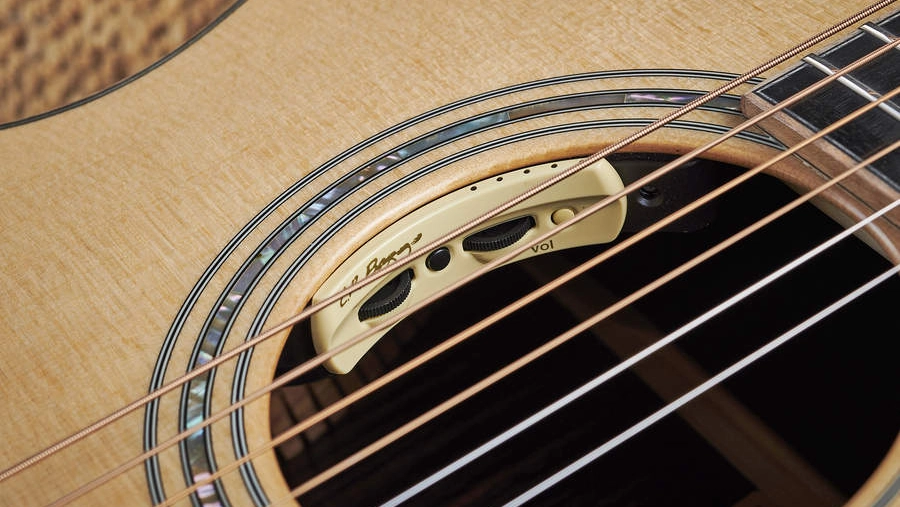
The majority of pickups on acoustic instruments are piezoelectric. There is another type of pickup based on magnets: magnetic pickups. These are mainly used on electric guitars. It is extremely rare to find them on acoustic instruments. Piezoelectric pickups are almost exclusively used on all acoustic instruments: folk guitar, classical guitar, mandolin, violin, cello, banjo, and many more.
Due to the different methods of interpreting the signal, the sound output is also very different between a microphone and a pickup.
The microphone preserves the main acoustic characteristics of the musical instrument. The capture of vibrations is done through the air. Our hearing is accustomed to hearing sounds that travel through the air. Every sound reaching your ears has traveled through the air! The sound of a violin travels through the air before being heard by the musician and their audience. Indeed, the resonant body of your violin naturally amplifies the sound produced, which then propagates through the room in which you are playing. Hence, the sensation that the sound produced by a microphone is more natural and acoustic. It preserves the very essence of your instrument.
On the other hand, the pickup does not allow the sound to travel through the air. It detects the mechanical vibrations produced by the movement of the strings. There is no acoustic process in its operation. Everything is based on physical detection. As a result, our hearing perceives the produced sound as unnatural. It lacks the resonance offered by air propagation. The sound produced by a pickup is described as dry and direct. It is not favored by musicians!
The dry sound produced by a pickup can be improved using various effects. Violinists, violists, cellists, and double bassists know that it’s necessary to use some effect pedals to transform it. The simple use of a reverb and delay pedal will already greatly improve the final output. These two effects add breadth and presence to the sound of the musical instrument.
Now that you know that the pickup produces a less appreciated sound, you may be wondering why musicians prefer it over the microphone. The pickup doesn’t have the advantage in terms of acoustic transmission, but it offers other benefits.
PROS
Easy to amplify
No feedback
CONS
Degraded sound quality
No acoustics
Captures all frequencies
PROS
Preservation of acoustics
Frequency range adapted to the instrument
CONS
Complex to amplify
Risk of feedback
Limited sound power
The main limitation of the microphone is feedback. This is a looping effect that produces a high-pitched, shrill sound, extremely unpleasant to hear. Feedback occurs when the microphone picks up a sound it just produced. A continuous loop of this sound is created, which is infinitely diffused through a speaker. This produces that unpleasant noise!
Since the pickup doesn’t rely on electroacoustic transduction, it is much less sensitive to feedback, making it highly advantageous for live performances! Indeed, the louder the volume, the more likely feedback will occur!
One of the drawbacks of the pickup is that it doesn’t target any specific frequency range! Its properties capture all vibrations, both good and bad, and everything is transmitted in the final audio signal! It’s impossible to limit them without using effects like an equalizer.
Conversely, the microphone is designed to respond within a particular frequency range, which determines its ability to reproduce the frequencies it captures. For example, a microphone can have a frequency range from 20 Hz to 20 kHz.
If you choose to install a microphone on your bowed string instrument (violin, viola, cello, or double bass), there aren’t many options on the market. Many manufacturers have even limited their range by offering the same microphone for multiple instruments. There are microphones sold for violin, guitar, and clarinet! In this case, our argument about respecting frequency ranges no longer holds much relevance!
Many musicians complain about such microphones due to a lack of understanding of their technology! They are real microphones, regardless of your instrument, and they are prone to feedback! There is no miracle solution to eliminate it! Feedback can appear at any time during a performance!
If you choose to install a pickup, you have a wider range of products available! We had the opportunity to try several during studio recordings. They sometimes offer special features, but generally, they are quite similar to each other.
Be sure to choose the pickup suited to your instrument! A cello pickup is not suitable for a violin. However, violin and viola pickups, or cello and double bass pickups, are generally the same.
Prices vary greatly depending on the manufacturer!
A preamp is not essential but is recommended! For acoustic instruments with naturally low volume, the output volume is often low!
Moreover, most preamps offer useful settings (EQ, reverb, tone management). A preamp might suffice to generate a coherent sound. It can save you from investing in additional effect pedals later.
If you’re a musician playing primarily an acoustic instrument, the preamp is one of the best options! You’ll find dozens of preamps on the market! Two Notes models even allow the loading of impulse responses!
If you play both acoustic and electric instruments, each device offers its own advantages! You are free to choose the type (pedalboard composed of effect pedals, effect processor, etc.), model, and brand!
Once received, the installation step can be tricky!
For microphones, you can install them yourself. Conduct a few tests to select the location that offers the best sound capture!
You’ll notice that the microphone’s attachment systems are impractical or even outright unsuitable! Since these microphones are sold to fit all types of instruments, they come with a system “designed” for all kinds of musical instruments. Often, this makes them unsuitable for any instrument. Generally, there’s a clip for smaller instruments like viola and violin, and a clamp for larger instruments like guitar or cello.
You’ll need to get creative to install it properly and avoid capturing ambient noise.
For pickups, installation may require the assistance of a luthier. If you’re comfortable handling your instrument, go ahead! If you’re afraid of damaging it or slightly altering its structure, seek advice from your luthier. Indeed, some pickups are installed under the bridge or inserted into the bridge’s slots. This installation may sometimes require light sanding or removing the bridge. These are tasks to perform while being fully aware of the risks posed to your instrument (detuning all the strings, removing the bridge, modifying the structure of the bridge, etc.)
Now you’re equipped to amplify your violin, or any other acoustic instrument! All that’s left is to choose the microphone or pickup that best suits your needs, then install it to discover the joys (and difficulties) of amplification!

